

Specific Growth Rate (μ)
Specific growth rate (μ) describes the rate of biomass increase relative to the amount of biomass already present in a culture.
Specific Growth Rate (μ)
Specific growth rate (μ) describes the rate of biomass increase relative to the amount of biomass already present in a culture.
Specific growth rate, usually represented by the Greek letter μ, is a kinetic parameter that describes how rapidly a microbial or cellular population increases relative to the biomass already present. It is widely used in microbiology, biotechnology, fermentation science, and bioprocess engineering to quantify the growth of bacteria, yeast, fungi, and cultured cells.
What does specific growth rate represent?
The specific growth rate describes the proportional increase in biomass over time. Unlike an absolute biomass production rate, μ takes the existing biomass concentration into account, which makes it useful for comparing cultures that start with different amounts of cells.
During exponential growth, biomass increases at a rate proportional to the biomass already present. This behavior can be expressed as dX/dt = μX, where X is the biomass concentration, t is time, and μ is the specific growth rate. Its units are inverse time, commonly h-1.
Calculating Specific Growth Rate
During the exponential growth phase, specific growth rate can be calculated from two biomass measurements using the equation μ = [ln(X2) − ln(X1)] / (t2 − t1). Here, X1 and X2 are biomass concentrations measured at times t1 and t2.
A more robust approach is to use several measurements collected during exponential growth. Plotting ln(X) against time should produce an approximately linear region, and the slope of that region corresponds to μ.
Biomass can be estimated directly or indirectly. Measurements such as dry cell weight, viable cell concentration, or optical density may be used depending on the system. When optical density or another indirect signal is used, it is important to confirm that the signal remains proportional to biomass over the selected range. Detector saturation, cell aggregation, morphology changes, or background interference can affect the calculation.
Specific growth rate and doubling time
Specific growth rate is directly related to population doubling time. Under ideal exponential growth, doubling time can be calculated as td = ln(2) / μ. A higher μ therefore corresponds to a shorter doubling time, while a lower μ indicates slower population growth.
This relationship is frequently used to compare microbial strains, culture media, nutrient conditions, temperatures, and process strategies.
What factors affect specific growth rate?
The value of μ depends on both biological and environmental conditions. Important factors include:
- substrate and nutrient availability;
- temperature;
- pH;
- oxygen availability and oxygen transfer;
- inhibitory metabolites;
- osmolarity and medium composition;
- cellular physiology and strain characteristics.
In aerobic high-density cultures, for example, specific growth rate may decrease when cellular oxygen demand approaches or exceeds the oxygen transfer capacity of the cultivation system.
Applications of specific growth rate in bioprocessing
Specific growth rate is used to characterize microbial growth kinetics, compare culture conditions, optimize media, analyze metabolic behavior, and design batch, fed-batch, and continuous cultivation processes.
In fed-batch processes, feeding strategies may be designed to maintain a selected growth rate by controlling substrate availability. In continuous cultures operating under appropriate steady-state conditions, μ can also be related to the dilution rate. For these reasons, specific growth rate is an important variable in process modeling, scale-up, strain characterization, and bioprocess optimization.
Frequently asked questions about Specific Growth Rate
What are the units of specific growth rate?
Specific growth rate has units of inverse time. In fermentation and bioprocessing, it is commonly expressed as h-1.
What is the difference between growth rate and specific growth rate?
An absolute growth rate describes how much biomass increases per unit of time. Specific growth rate normalizes that increase to the biomass already present, making it more useful for comparing cultures.
Which part of a growth curve should be used to calculate μ?
The exponential growth phase is generally used when determining a characteristic or maximum specific growth rate, because ln(biomass) is approximately linear with time during this period.
Other terms with the letter "S"
View allStatic multiple light scattering
Static multiple light scattering (SMLS) is an optical technique that characterizes concentrated liquid dispersions in their native state, monitoring stability and particle size without dilution.
Surface tension
Surface tension is the energy required to increase a liquid surface area, or equivalently the force per unit length acting at an interface.
Surfactant
A surfactant is an amphiphilic substance that adsorbs at interfaces and modifies properties such as surface and interfacial tension.
Referenced products
4 4 products
Vi-CELL BLU
The Vi-CELL BLU is the most advanced cell viability analyzer, automating Trypan Blue Exclusion for fast and accurate analysis.

BioLector XT
The BioLector XT Microbioreactor will optimize your process. Precise control of pH, biomass, and DO with patented microfluidic technology and optical sensors.
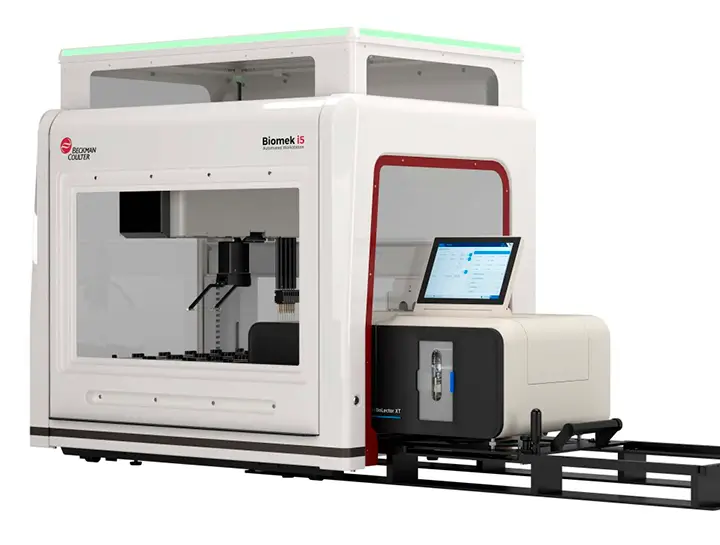
BioLector XT & Biomek i5
BioLector XT Microbioreactor with Biomek i5: Automation of microbial cultivation with real-time measurements. Reduce errors and increase productivity.

Vi-CELL MetaFLEX
The Vi-CELL MetaFLEX is the bioanalytical analyzer for pH, pO2, pCO2, glucose, lactate, and electrolyte analysis. 65 µL samples in 35s with low maintenance.
Stay in the loop
Get updates, articles and news by email.
Expect news about equipment, services and regulations tailored to your locale.