

ANSI/SLAS
ANSI/SLAS is a family of standards for microplate dimensions and well positions used in laboratories and automated systems.
ANSI/SLAS
ANSI/SLAS is a family of standards for microplate dimensions and well positions used in laboratories and automated systems.
What is ANSI/SLAS?
ANSI/SLAS is a family of technical standards that defines standardized dimensions for microplates used in laboratories, automated systems and scientific instruments. The standards cover characteristics such as plate footprint, height, bottom flange, well positions and well-bottom elevation.
ANSI stands for the American National Standards Institute, which coordinates voluntary standards in the United States. SLAS stands for the Society for Laboratory Automation and Screening, a scientific society that provides the platform and working group associated with microplate standardization.
The standards may also appear in older documents as ANSI/SBS. SBS referred to the Society for Biomolecular Screening, which later became part of SLAS. ANSI/SLAS is the recommended current reference.
What are ANSI/SLAS standards used for?
The standards allow microplates from different manufacturers to be handled by compatible instruments without requiring a unique holder or positioning system for every plate. This standardization supports microplate readers, washers, incubators, liquid handlers, stackers, plate centrifuges and microbioreactors.
In automated systems, small differences in external dimensions or well positions may cause pipetting errors, inaccurate readings, mechanical collisions and incorrect plate positioning. Dimensional compliance reduces these risks and improves interoperability between laboratory consumables and instruments.
What are the main ANSI/SLAS microplate standards?
- ANSI/SLAS 1-2004: defines microplate footprint dimensions.
- ANSI/SLAS 2-2004: establishes microplate height dimensions.
- ANSI/SLAS 3-2004: specifies bottom outside flange dimensions.
- ANSI/SLAS 4-2004: defines the center positions of microplate wells.
- ANSI/SLAS 6-2012: covers well-bottom elevation.
These standards are complementary. A claim that a plate complies with ANSI/SLAS should identify the applicable documents because each standard addresses a different dimensional characteristic.
Well positions and microplate formats
The well-position standard covers common 96-, 384- and 1,536-well formats. A 96-well plate, for example, has eight rows and twelve columns. Higher-density formats use smaller distances between well centers.
Standardized positioning allows a liquid handler to locate every well and enables a plate reader to align its measurement area correctly. This is particularly important in high-throughput workflows involving hundreds or thousands of automated liquid transfers.
Laboratory and industrial applications
The ANSI/SLAS format is used in ELISA, cell culture, microbiology, molecular biology, drug discovery, enzyme assays and quality control. It is also used for microbioreactor plates in which wells function as small cultivation vessels.
Although the external format is standardized, working volume, well geometry, material, color and surface treatment may vary. ANSI/SLAS compliance does not mean that every plate is suitable for every assay or instrument.
Does ANSI/SLAS define the number of wells in a plate?
The family includes well-position requirements for formats such as 96, 384 and 1,536 wells, but it does not require every plate to contain the same number. Plates with different well counts or specialized geometries may use the standardized external footprint.
Will an ANSI/SLAS plate work in every microplate reader?
Not necessarily. Dimensional standardization improves mechanical compatibility, but users must also verify plate height, well bottom, material, optical properties, lid, working volume and instrument configuration.
What is the difference between ANSI/SLAS and SBS?
SBS is the historical designation associated with the Society for Biomolecular Screening. Following organizational changes, the standards became known as ANSI/SLAS. Some manufacturers still use the term SBS format in technical documentation.
Referenced products
2 2 products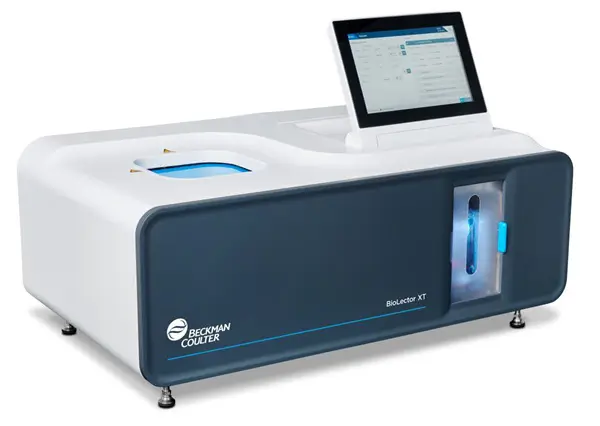
BioLector XT
The BioLector XT Microbioreactor will optimize your process. Precise control of pH, biomass, and DO with patented microfluidic technology and optical sensors.
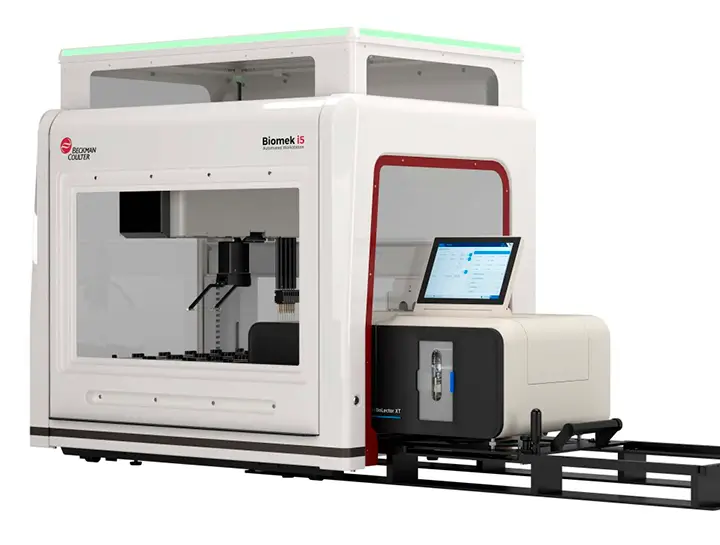
BioLector XT & Biomek i5
BioLector XT Microbioreactor with Biomek i5: Automation of microbial cultivation with real-time measurements. Reduce errors and increase productivity.
Stay in the loop
Get updates, articles and news by email.
Expect news about equipment, services and regulations tailored to your locale.