

Zeta potential
Zeta potential is an electrokinetic parameter related to particle surface charge and the stability behavior of colloidal dispersions.
Zeta potential
Zeta potential is an electrokinetic parameter related to particle surface charge and the stability behavior of colloidal dispersions.
Zeta potential is an electrokinetic parameter used to evaluate the behavior of particles dispersed in a liquid, and it is commonly associated with effective surface charge and the tendency of colloidal systems to remain dispersed or aggregate. Zeta potential measurements are widely used in research involving nanoparticles, extracellular vesicles, emulsions, proteins, polymers and other dispersed systems.
What is zeta potential?
When a particle is dispersed in a liquid, ions in the surrounding medium interact with its surface and form an organized charge region around the particle. This behavior is commonly described using the electrical double layer model. Zeta potential corresponds to the electrical potential associated with the slipping plane as the particle moves through the liquid.
Zeta potential is usually expressed in millivolts (mV) and can be positive or negative. Its sign and magnitude depend on factors including surface chemistry, pH, ionic strength, salts, surfactants, proteins and other adsorbed molecules.
How is zeta potential measured?
Zeta potential measurements are generally based on the movement of charged particles under an applied electric field. This movement, known as electrophoretic mobility, can be converted into zeta potential using models appropriate for the properties of the sample and measurement conditions.
Because the result strongly depends on experimental conditions, parameters such as temperature, medium composition, conductivity, pH and sample concentration should be considered during interpretation. Comparisons between samples are generally more meaningful when measurements are performed under equivalent conditions.
What is the relationship between zeta potential and stability?
Zeta potential is frequently used as an indicator of the tendency of a dispersion to remain stable. In many systems, a higher absolute zeta potential is associated with stronger electrostatic repulsion between particles, which may reduce their tendency to aggregate. However, zeta potential should not be interpreted as a universal or isolated measure of stability.
Steric interactions, chemical composition, particle concentration, viscosity and other forces can also influence dispersion behavior. Interpretation should therefore consider the formulation and the primary mechanism responsible for stabilization.
Zeta potential of nanoparticles and extracellular vesicles
In nanoparticle and extracellular vesicle research, zeta potential can provide information about surface properties, interactions with the surrounding medium and changes caused by chemical modification, protein adsorption or variations in sample composition.
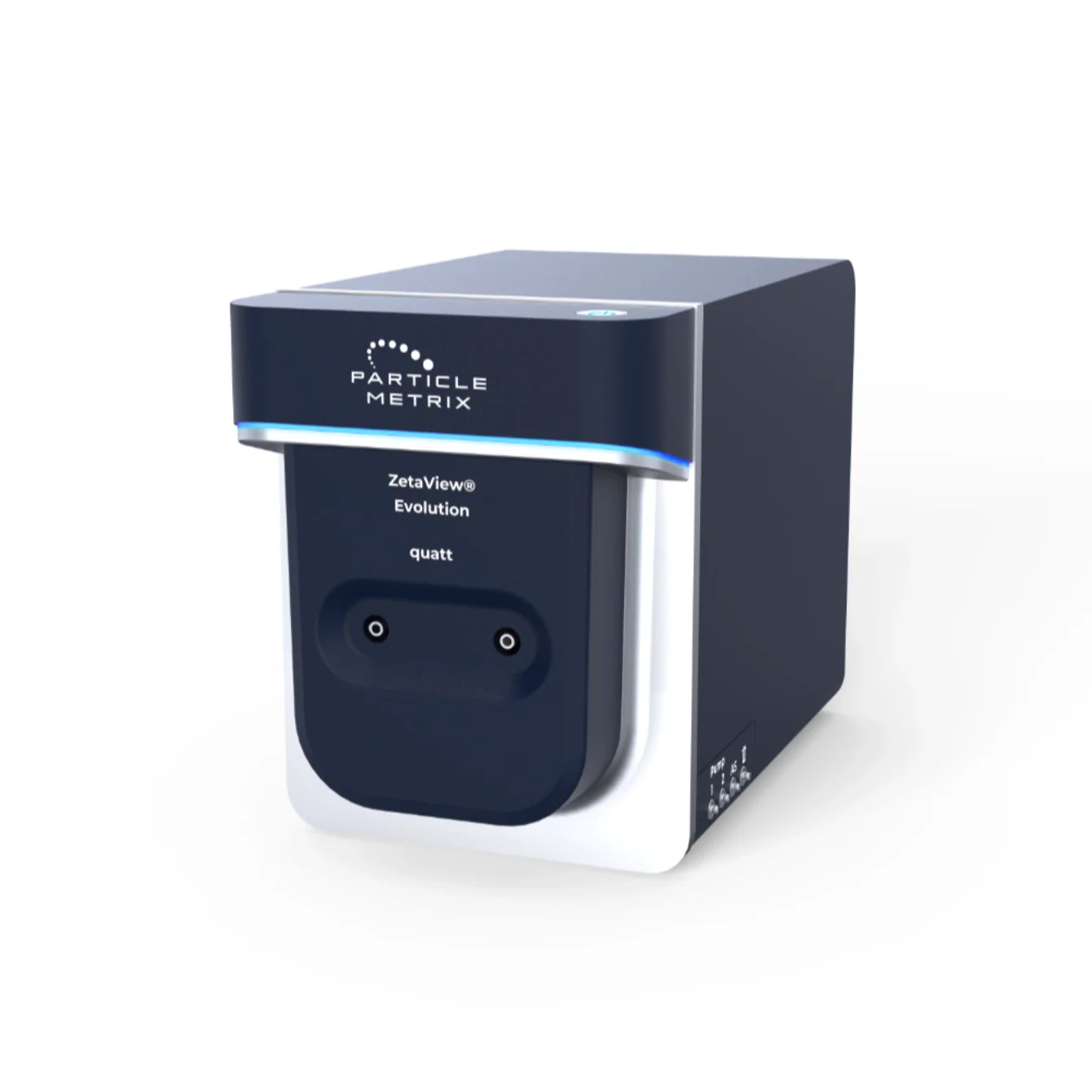
When the objective is to combine zeta potential with particle size, concentration and fluorescence measurements, multiparametric platforms can provide complementary information within a single analytical workflow. The ZetaView Evolution supports zeta potential analysis together with NTA, particle concentration, size distribution and fluorescence capabilities, making it applicable to extracellular vesicle and nanoparticle research.
Applications of zeta potential in laboratory and industry
Zeta potential measurements are used across scientific and industrial fields to investigate particle stability, surface interactions and changes in particle chemistry.
- Characterization of nanoparticles and nanomaterials.
- Research involving extracellular vesicles and exosomes.
- Evaluation of suspension and dispersion stability.
- Development of pharmaceutical formulations.
- Research on emulsions and colloidal systems.
- Characterization of surface-modified particles.
- Studies of protein and biomolecule adsorption.
- Optimization of pH and ionic composition.
What does positive or negative zeta potential mean?
The sign indicates the polarity of the electrical potential at the particle slipping plane. Positive or negative values can result from surface chemistry, medium pH and adsorption of ions or molecules. The sign alone does not determine whether a dispersion is stable or unstable.
What zeta potential value indicates good stability?
There is no universal threshold that applies to every formulation. High absolute values are often associated with stronger electrostatic repulsion, but sterically stabilized systems can remain stable even when zeta potential values are relatively low. Results must be interpreted in the context of sample composition and stabilization mechanism.
Why does pH affect zeta potential?
Changes in pH can alter the ionization of chemical groups on particle surfaces and modify the distribution of surrounding ions. As a result, zeta potential can vary substantially with pH. Measurements across a pH range can help researchers understand surface behavior and identify conditions associated with reduced colloidal stability.
Stay in the loop
Get updates, articles and news by email.
Expect news about equipment, services and regulations tailored to your locale.