

Exosome purification
Exosome purification reduces contaminants and enriches vesicles of interest for subsequent physical, molecular and functional analysis.
Exosome purification
Exosome purification reduces contaminants and enriches vesicles of interest for subsequent physical, molecular and functional analysis.
Exosome purification is the process used to enrich extracellular vesicles of interest while reducing proteins, lipoproteins, aggregates and other components present in biological samples. The appropriate purification strategy depends on sample type and volume, required purity and the downstream analyses that will be performed.
What is exosome purification?
Exosomes are extracellular vesicles associated with the endosomal pathway and released by cells into the extracellular environment. In biological fluids and cell culture media, these vesicles coexist with structures that may have similar dimensions and physicochemical properties. Obtaining a vesicle-enriched preparation therefore requires methods that separate sample components according to characteristics such as size, density or molecular affinity.
In practice, the term exosome purification is frequently used to describe procedures designed to obtain preparations enriched in small extracellular vesicles. Because establishing endosomal origin requires additional evidence, particle identity should be interpreted using complementary characterization rather than the purification method alone.
What are the main methods for exosome purification?
Several strategies can be used to separate and purify extracellular vesicles. Each technique has advantages and limitations involving recovery, purity, processing time and the final characteristics of the preparation.
- Ultracentrifugation: uses high centrifugal forces to separate particles based on properties such as size and density.
- Density gradient separation: separates components according to their buoyant density.
- Size-exclusion chromatography (SEC): separates particles and molecules primarily according to hydrodynamic size.
- Ultrafiltration: uses membranes to concentrate or separate particles according to defined size limits.
- Immunoaffinity: uses capture molecules directed toward markers associated with specific vesicle populations.
- Precipitation: uses reagents that modify particle solubility to facilitate recovery.
Some workflows combine two or more techniques sequentially to balance recovery and purity. The appropriate strategy depends on the application and the initial composition of the sample.
What is the difference between exosome isolation and purification?
Isolation and purification are related terms but are not necessarily equivalent. Isolation generally refers to separating or enriching vesicles from a complex sample. Purification places greater emphasis on removing unwanted components and obtaining a relatively cleaner particle population.
A preparation containing a high particle concentration is not necessarily highly purified. Proteins, aggregates, lipoproteins and other particles may remain in the sample and influence downstream measurements. Particle yield and purity should therefore be evaluated separately.
How are exosomes evaluated after purification?
After purification, characterization can evaluate particle size, concentration, morphology, molecular markers and surface properties. Complementary methods are important because none of these properties alone establishes that an individual particle is an exosome.
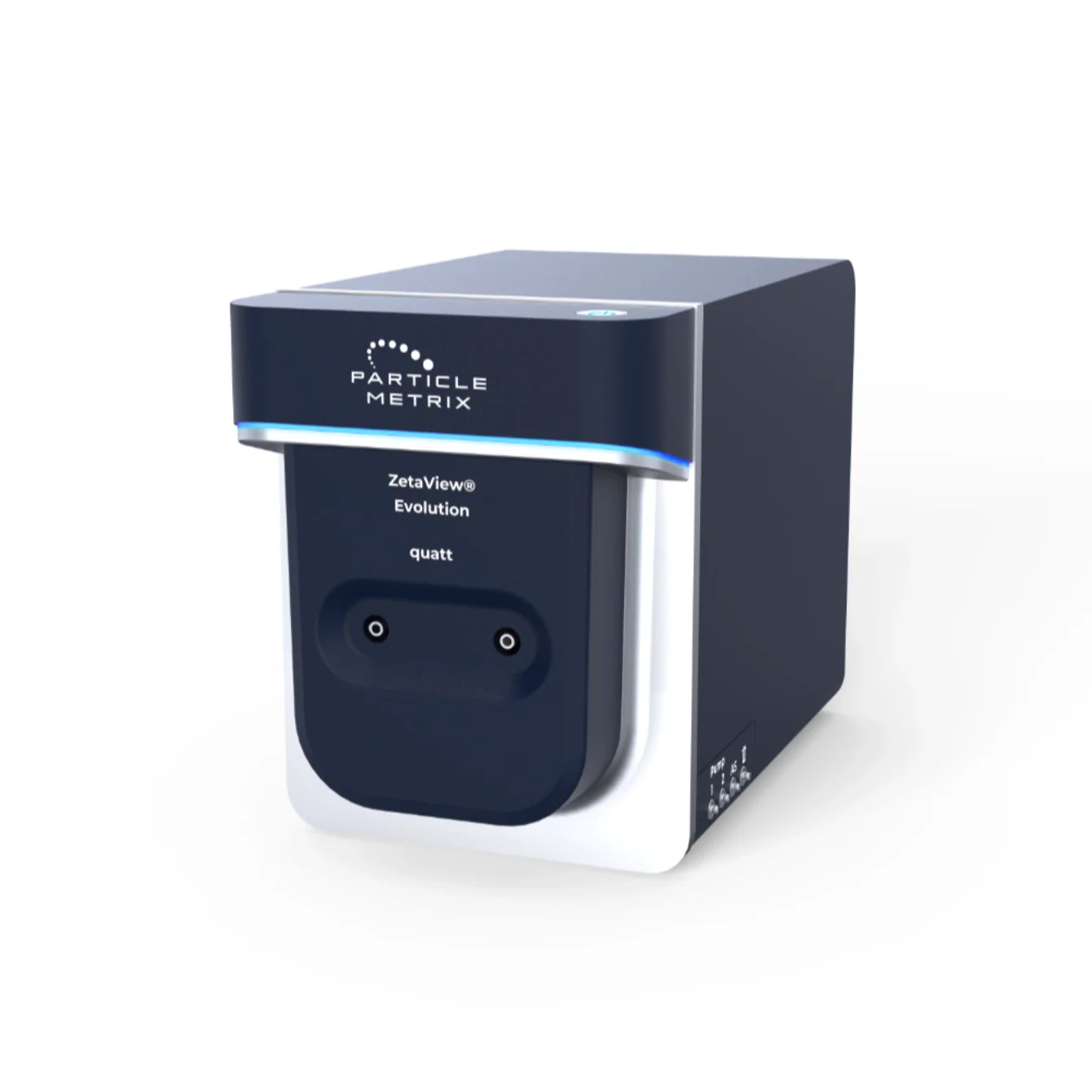
Nanoparticle tracking analysis (NTA) can determine particle size distribution and concentration in suspension. When information about labeled populations is required, fluorescence can complement physical characterization. The ZetaView Evolution combines NTA, fluorescence analysis and zeta potential measurements, providing multiple parameters for evaluating extracellular vesicles after isolation and purification workflows.
Applications of exosome purification
The quality of an extracellular vesicle preparation can directly influence experimental results. Purification workflows are therefore relevant across biomedical and biotechnology research.
- Biomarker research in biological fluids.
- Analysis of vesicle-associated proteins and nucleic acids.
- Studies of intercellular communication.
- Cancer and disease research.
- Functional studies involving extracellular vesicles.
- Development of molecular delivery systems.
- Regenerative medicine research.
- Comparison and validation of EV preparation protocols.
What is the best method for exosome purification?
There is no universally superior method. The appropriate approach depends on sample type, available volume, experimental objective and the required balance between recovery and purity. For some applications, combining methods can produce a more suitable preparation than a single separation step.
How can you determine whether an exosome sample is pure?
Purity should be assessed using multiple approaches. In addition to particle size and concentration, researchers can evaluate vesicle-associated markers and potentially contaminating components. Relationships between particle number and other sample components may also provide useful information about preparation quality.
Can purification affect exosomes?
Processing methods can influence recovery, aggregation, concentration and other characteristics of the preparation. The protocol should therefore be selected according to downstream analysis and the need to preserve relevant vesicle properties.
Other terms with the letter "E"
View allExtracellular Vesicles
Extracellular vesicles are cell-released nanoparticles that carry proteins, lipids and genetic material, enabling cell-to-cell communication.
Endosomal Compartment of Cells
A system of organelles that receives, sorts, and directs internalized cellular cargo toward recycling, degradation, or other destinations.
Exosomes
Exosomes are small extracellular vesicles released by cells that transport biomolecules and participate in intercellular communication.
Extracellular vesicle isolation
Extracellular vesicle isolation separates and enriches EVs from biological fluids or culture media for subsequent analysis and characterization.
Extracellular vesicle characterization
Extracellular vesicle characterization uses complementary techniques to evaluate EV size, concentration, markers and physicochemical properties.
Exosome biomarkers
Exosome biomarkers are vesicle-associated molecules used to investigate EV origin, composition and potential biological functions.
Stay in the loop
Get updates, articles and news by email.
Expect news about equipment, services and regulations tailored to your locale.