

Reducing oxygen limitation in high-density microbial cultures requires balancing oxygen availability with growth rate and substrate feeding .
In the Application Note Aerobic cultivation of high-oxygen-demanding microorganisms in the BioLector XT microbioreactor , Beckman Coulter Life Sciences investigated this relationship using the BioLector XT microbioreactor in cultures of Escherichia coli and Vibrio natriegens , comparing different feeding strategies under atmospheric air and oxygen-enriched air.
In fed-batch processes, supplying more glucose without ensuring sufficient O₂ transfer can cause dissolved oxygen (DO) levels to fall, reduce the specific growth rate , and promote metabolic shifts and the formation of by-products such as acetate, lactate, and ethanol.
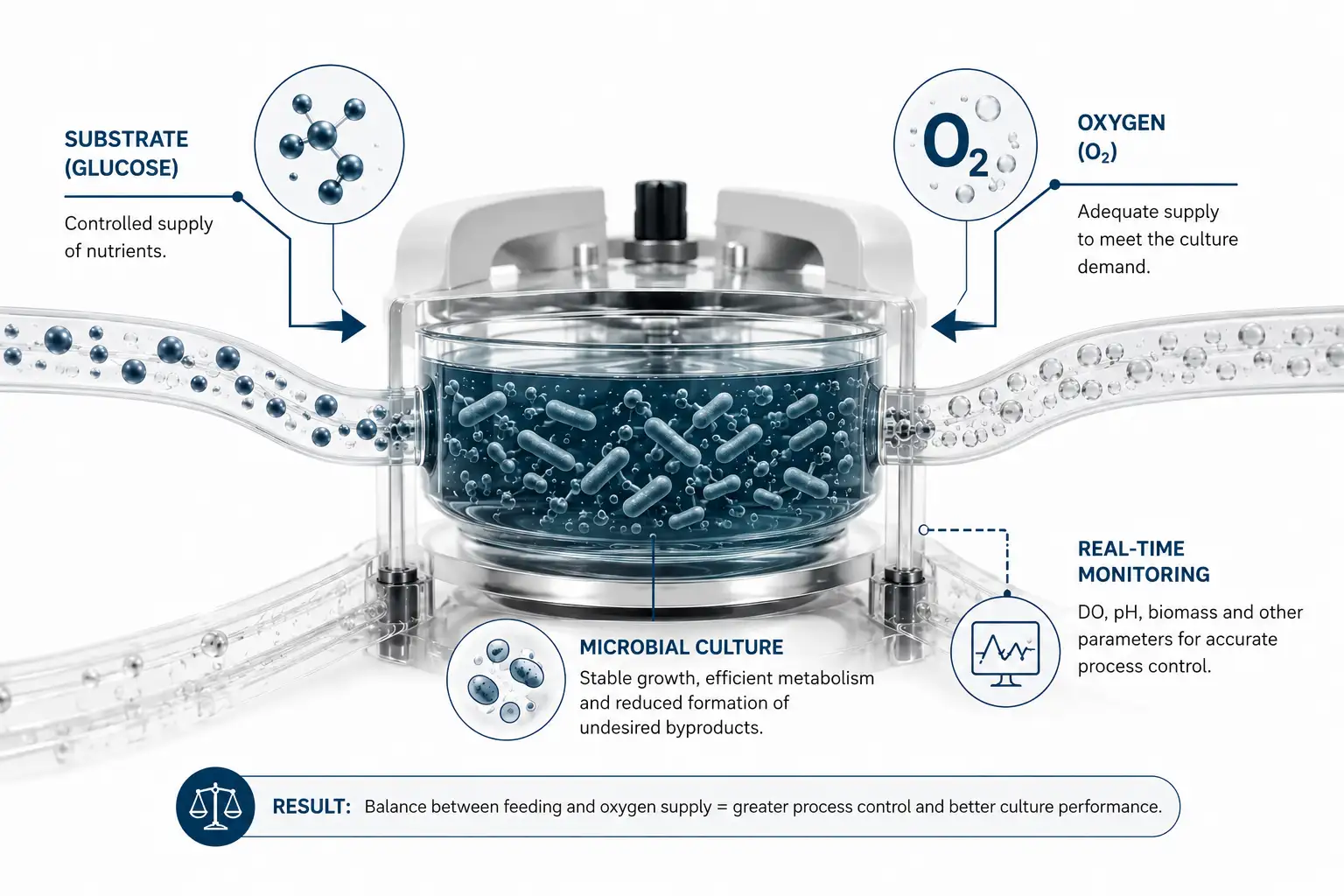
Increasing the oxygen concentration, however, is not a standalone solution either, since high O₂ concentrations may promote the formation of reactive oxygen species (ROS) .
In high-density cultures, substrate feeding and oxygen availability need to be evaluated together.
Why Does Oxygen Become a Challenge in High-Density Cultures?
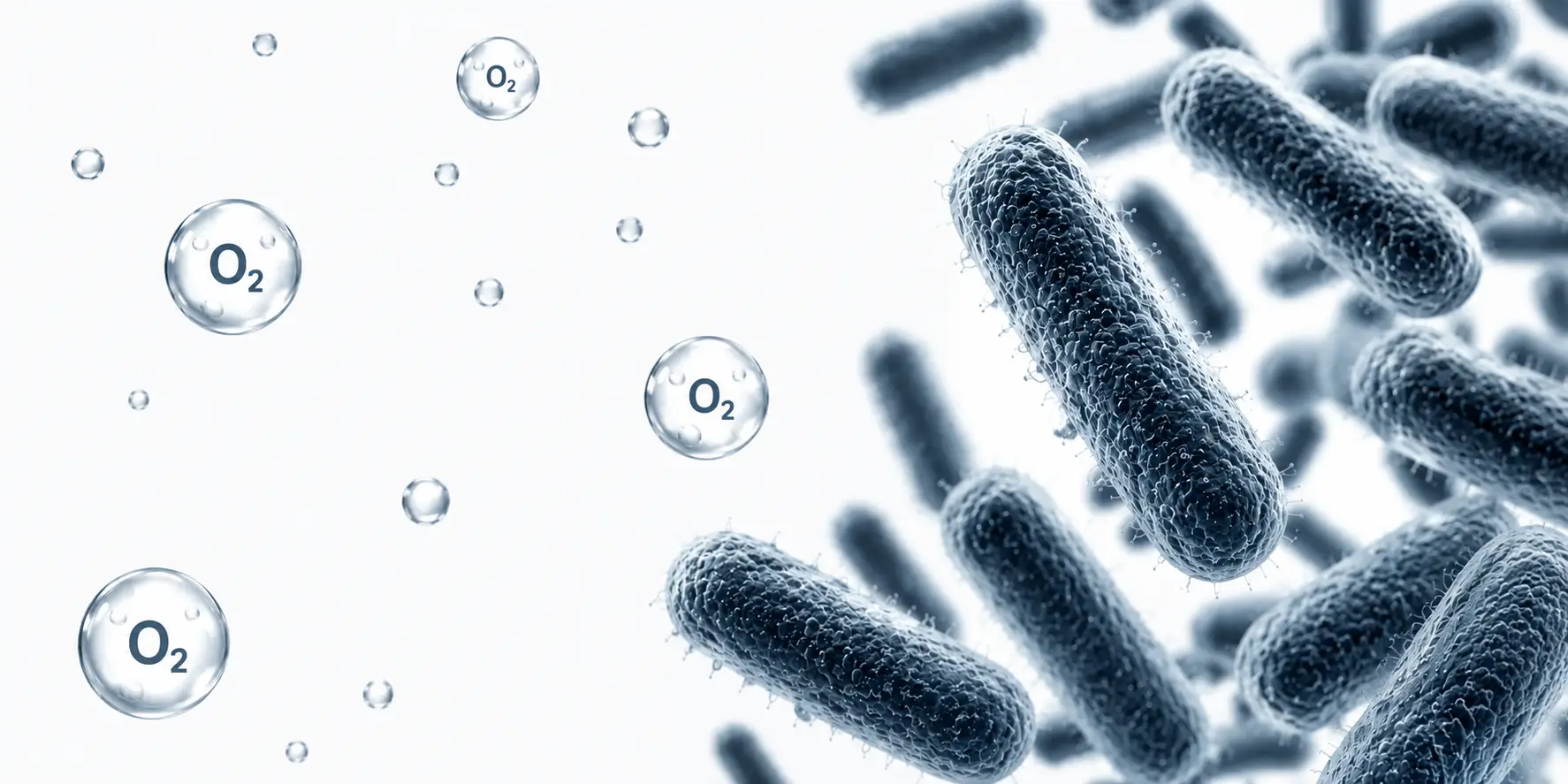
As biomass increases, so does the metabolic demand for oxygen. If O₂ transfer cannot keep pace with cellular consumption, dissolved oxygen can fall to critically low levels.
The impact is not limited to slower growth. Oxygen limitation can alter cellular metabolism and promote the formation of unwanted metabolites. In E. coli , for example, acetate formation is associated with what is known as overflow metabolism.
This is why increasing substrate feeding does not necessarily improve culture performance. Greater glucose availability and faster growth can also result in a higher oxygen demand.
This challenge becomes particularly evident in very fast-growing microorganisms.
Vibrio natriegens : Rapid Growth and High Oxygen Demand
Vibrio natriegens is a Gram-negative bacterium known for its exceptionally rapid growth, with reported generation times of only 9.4 minutes under optimal conditions . This characteristic makes the microorganism an attractive platform for biotechnology applications, but it is also associated with high glucose and oxygen consumption rates.
A previous study cited in the Application Note reported high-cell-density fed-batch cultivation of V. natriegens with oxygen uptake rates reaching 500 mmol·L⁻¹·h⁻¹ . Under those conditions, air enriched to 60% oxygen was used to maintain DO at 40% of air saturation.
This leads to an important question in bioprocess development:
“
How much substrate can be supplied before the metabolic demand exceeds the oxygen transfer capacity of the culture?
How Was the Experiment Conducted?
To investigate this relationship, the researchers used the BioLector XT equipped with a microfluidic module and a Gen2 Microfluidic FlowerPlate.
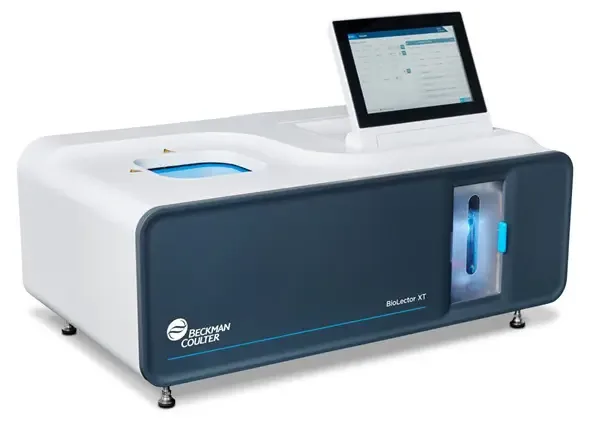
The setup enabled real-time monitoring of biomass, pH, and DO while also allowing control over feeding and gas composition. In this Application Note, the experiments specifically compared atmospheric air containing 21% O₂ with oxygen-enriched air containing up to 50% O₂ , both at a fixed flow rate of 50 mL/min. ( Beckman Coulter )
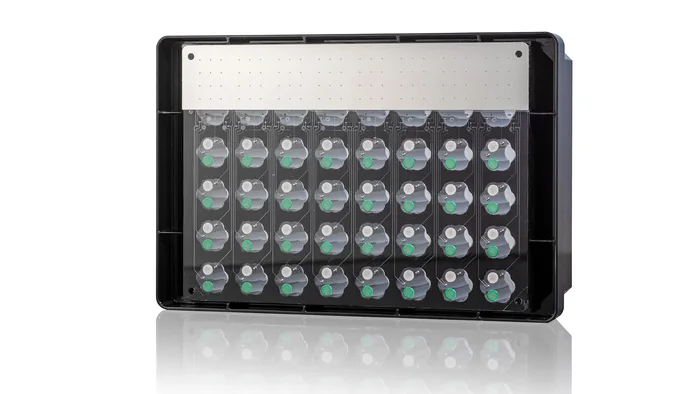
Figure 2 illustrates the experimental configuration. The plate contains 32 cultivation wells equipped with optodes for optical pH and DO measurements. Reservoirs are connected to the cultivation wells through microfluidic channels, enabling controlled addition of solutions throughout the experiment.
What Happened to E. coli When Oxygen Became Limiting?
In fed-batch E. coli cultures using a constant feeding strategy, differences between the oxygen conditions became apparent shortly after glucose feeding began.
Under atmospheric air, oxygen transfer was no longer sufficient to meet the demand of the culture, resulting in O₂ limitation for the remainder of the experiment. Under the oxygen-enriched conditions evaluated, the culture maintained exponential growth for longer and reached a higher biomass concentration than the oxygen-limited culture.
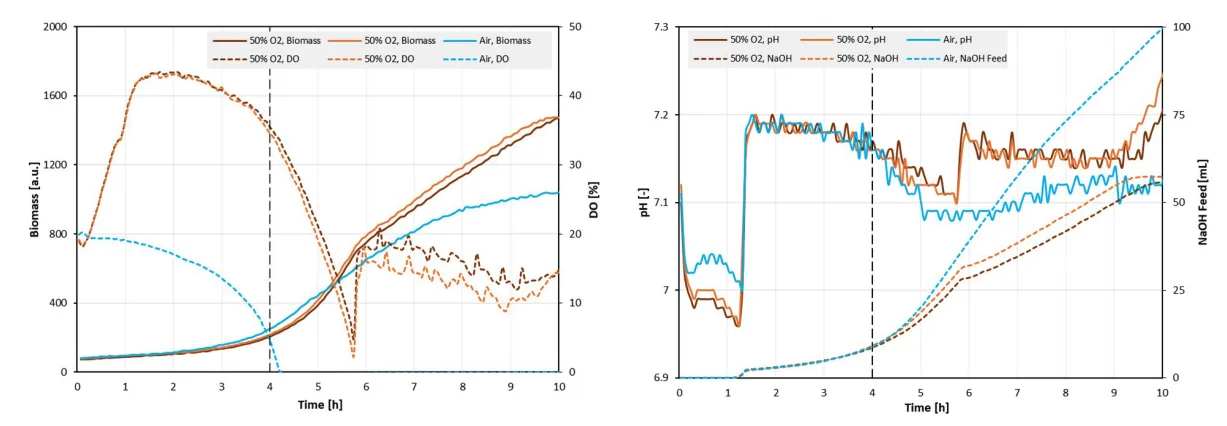
In Figure 3, the main point to observe is the decrease in DO after feeding begins and the difference between the profiles obtained under atmospheric air and oxygen-enriched conditions.
pH behavior also changed. The oxygen-limited culture required greater NaOH addition and, even so, the pH remained approximately 0.1 units below the setpoint. The authors suggest that increased formation of secondary metabolites such as acetate, associated with overflow metabolism, could explain this acidification.
Oxygen limitation affected more than growth. The results also pointed to a change in the metabolic behavior of the culture.
The researchers repeated the comparison using a linearly increasing feeding profile.
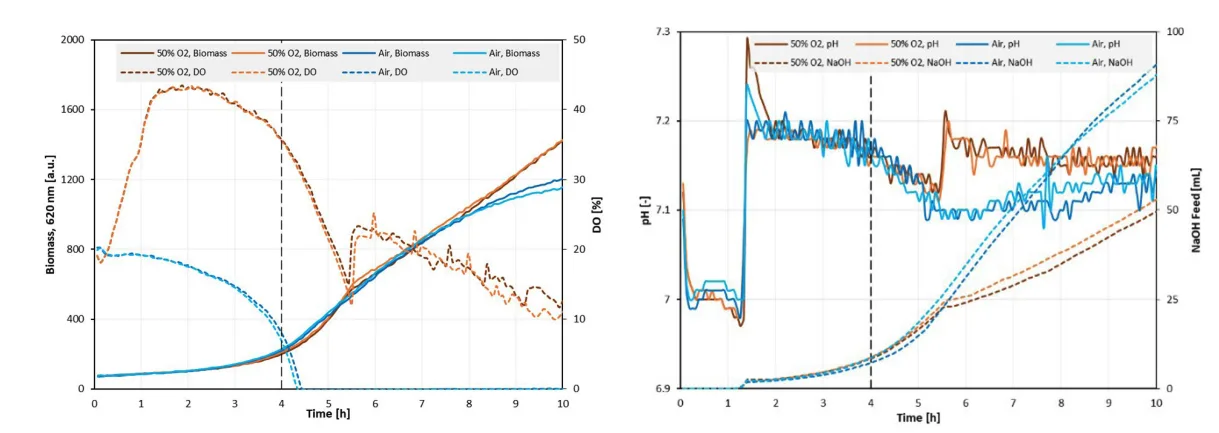
Figure 4 shows that the overall behavior was reproduced. Under the tested conditions, cultures supplied with atmospheric air became oxygen limited shortly after feeding began, whereas O₂ enrichment prevented this limitation during the period analyzed.
These results reinforce that feed rate and oxygen availability are interdependent variables when developing a fed-batch cultivation strategy.
What If Dissolved Oxygen Controls the Feeding Strategy?
In the V. natriegens experiment, the researchers moved beyond a fixed feeding rate and used DO itself as a signal to control substrate addition.
For this specific experiment, the system was configured to add 4 µL of glucose-rich feeding solution whenever DO was above 6% . The 6% threshold was defined for this particular experimental strategy and should not be interpreted as a universal limit for other cultures.
The control logic is straightforward.
When DO rises above the defined threshold, feeding solution is added. Once glucose becomes available, aerobic metabolism increases oxygen consumption and DO decreases. When DO falls below the established threshold, feeding is stopped. After the substrate is consumed and DO recovers, another feeding event can be triggered.
Dissolved oxygen is no longer simply a monitored variable; it becomes an active part of the feeding control strategy.
More Than 30 DO-Controlled Feeding Cycles
Figure 5 clearly illustrates the difference between V. natriegens cultures under the two oxygenation conditions.
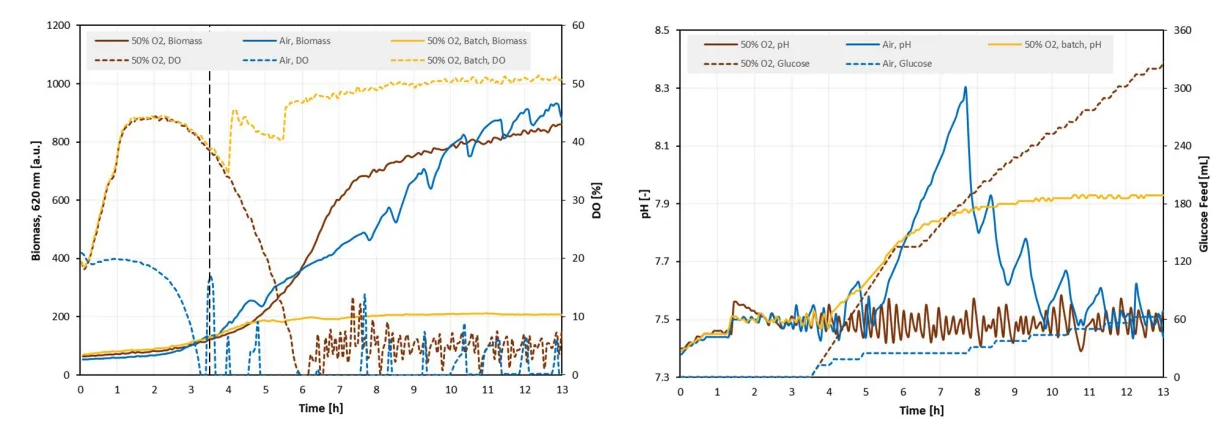
With 50% O₂, oxygen enrichment maintained DO above 6% for approximately 5.75 hours. The culture eventually reached oxygen limitation at around 6 hours, causing feeding to stop until DO recovered.
From that point onward, the control mechanism alternated between feeding and pausing according to oxygen availability.
This cycle was repeated more than 30 times , resulting in the addition of almost 200 µL of glucose-rich feeding solution during the remaining 6.5 hours of the experiment. None of these individual feeding events resulted in complete oxygen depletion in the liquid phase.
Compared with atmospheric air, the oxygen-enriched culture received more than five times as much feeding solution . Under atmospheric air, longer periods of complete oxygen depletion occurred after feeding pulses and were accompanied by more irregular biomass and pH behavior.
The authors interpreted these fluctuations as indications of metabolic changes, including the possible temporary utilization of acids produced as overflow metabolites. Because these metabolites were not directly quantified in the experiment, this interpretation should be considered a hypothesis based on the observed DO, pH, and biomass profiles.
Does More Oxygen Necessarily Mean More Biomass?
No.
Despite receiving a substantially greater amount of feeding solution, the final biomass concentration of V. natriegens was quite similar between the two fed-batch cultures presented.
The authors suggest that the relatively low biomass formation under oxygen-enriched conditions may indicate a lower glucose-to-biomass yield and possibly greater formation of products or overflow metabolites. However, these compounds were not directly quantified in the experiment.
This result is important because it demonstrates that oxygen enrichment does not automatically translate into greater biomass or higher productivity .
The value of oxygen control lies in expanding the process conditions that can be investigated and making cultivation more controllable, rather than simply supplying more O₂.
What Do These Results Mean for Bioprocess Development?
These experiments show that fed-batch process development must consider not only how much substrate is supplied, but also how much substrate the microorganism can metabolize within the available oxygen transfer conditions.
Continuous monitoring of biomass, pH, and DO also makes it possible to use these signals when developing closed-loop control strategies, as demonstrated by DO-triggered feeding in the V. natriegens experiment.
This combination of capabilities is precisely what the BioLector XT enabled researchers to explore in this work:
- parallel microscale cultivation,
- online monitoring of culture parameters,
- microfluidic feeding control, and
- adjustment of gas composition.
How Can This Approach Be Applied to Bioprocess Development?
The BioLector XT platform provides real-time monitoring of parameters such as biomass, fluorescence, pH, and dissolved oxygen, along with options for microfluidic feeding and pH control and adjustment of the gas composition.
For laboratories working on bioprocess development and optimization, this approach makes it possible to investigate at microscale how different combinations of feeding, oxygenation, and control parameters influence culture behavior.
Innotec Latam , together with Beckman Coulter Life Sciences , supports researchers and bioprocess teams interested in evaluating the BioLector XT for microbial cultivation and process development strategies.
Would you like to explore how feeding, pH, and dissolved oxygen control could be applied to your cultures? Contact Innotec Latam to learn more about the possibilities offered by the BioLector XT for microscale bioprocess development.
Frequently Asked Questions About Oxygenation and Fed-Batch Microbial Cultivation
1. What Causes Oxygen Limitation in High-Density Microbial Cultures?
Oxygen limitation occurs when the cells' metabolic demand for O₂ exceeds the system's capacity to transfer oxygen into the culture medium. As biomass concentration and growth rate increase, oxygen consumption may also rise. This is why substrate feeding rate and oxygen availability need to be evaluated together in high-density cultures.
2. What Is the Relationship Between Glucose, Dissolved Oxygen, and Overflow Metabolism in E. coli ?
In fed-batch E. coli cultures, increasing glucose availability can increase metabolic activity and consequently raise oxygen demand. When this demand exceeds the O₂ transfer capacity of the system, oxygen limitation occurs and metabolic changes may develop. In the study discussed here, the authors associated the greater acidification observed under oxygen-limited conditions with the possible increased formation of secondary metabolites such as acetate related to overflow metabolism.
3. What Is Dissolved Oxygen-Controlled Feeding in a Fed-Batch Culture?
It is a control strategy in which dissolved oxygen (DO) is used as a signal to determine when substrate should be added. In the Vibrio natriegens experiment, 4 µL of glucose-rich feeding solution was added whenever DO was above 6%. When metabolic consumption caused DO to fall below that threshold, feeding was stopped until oxygen levels recovered. The 6% threshold was specific to this experimental strategy and should not be considered a universal value for other cultures.
4. Why Does Vibrio natriegens Present Particular Oxygenation Challenges?
Vibrio natriegens is an exceptionally fast-growing bacterium and can therefore exhibit high metabolic demand for both substrate and oxygen. The article cites reported generation times of 9.4 minutes under optimal conditions and a previous high-cell-density fed-batch study that reached oxygen uptake rates of up to 500 mmol·L⁻¹·h⁻¹. These characteristics make balancing feeding and oxygen transfer capacity particularly important during process development.
5. Does Increasing the Oxygen Concentration Always Increase Biomass?
No. In the V. natriegens experiment, the oxygen-enriched culture received more than five times as much feeding solution as the atmospheric-air condition, yet the final biomass concentration was quite similar between the two cultures. The authors suggested a potentially lower glucose-to-biomass yield and greater formation of products or overflow metabolites, but these compounds were not directly quantified. Greater oxygen availability therefore should not automatically be interpreted as greater biomass production.
6. Which Parameters Should Be Monitored to Control a Microscale Fed-Batch Culture?
In the study discussed here, biomass, pH, and dissolved oxygen were monitored in real time. The BioLector XT also enabled microfluidic feeding control and modification of the gas composition. Combining these variables made it possible to assess how feeding and oxygenation affected culture behavior and, in the V. natriegens experiment, to use DO itself as part of a closed-loop control strategy.
7. How Can the BioLector XT Be Used to Optimize Microbial Bioprocesses?
The BioLector XT enables parallel microscale cultivations while monitoring parameters such as biomass, fluorescence, pH, and dissolved oxygen in real time. The platform also offers options for microfluidic feeding and pH control and adjustment of the gas composition. These capabilities allow researchers to investigate different combinations of feeding, oxygenation, and control parameters during bioprocess development and optimization.
Recommended Reading
- High-cell-density fed-batch cultivations of Vibrio natriegens - View the article on PubMed
- Avoiding acetate accumulation in Escherichia coli cultures using feedback control of glucose feeding - View the article on PubMed
- Control and regulation of acetate overflow in Escherichia coli - Read the full article