

Subvisible Particle Control in Injectables: Analytical Criteria and Compliance with the Argentine Pharmacopoeia
The control of subvisible particles in injectable medicines requires more than instrumental particle counting in liquids . Procedure selection, sample preparation, sensor suitability, and interpretation of results must comply with the applicable pharmacopoeial specifications.
In Argentina, Chapter <650> — Particulate Matter in Injections, of the Argentine Pharmacopoeia , describes light obscuration and microscopic particle counting procedures, including analytical conditions and acceptance limits for different pharmaceutical presentations.
For quality control laboratories, applying these requirements involves decisions that can directly affect result reliability and batch compliance assessment. These activities are also part of the Good Manufacturing Practices (GMP) framework overseen by ANMAT, which encompasses documentation, equipment qualification, and quality control procedures.
1. Applicability of Chapter 650: How Should the Procedure Be Selected for Each Preparation?
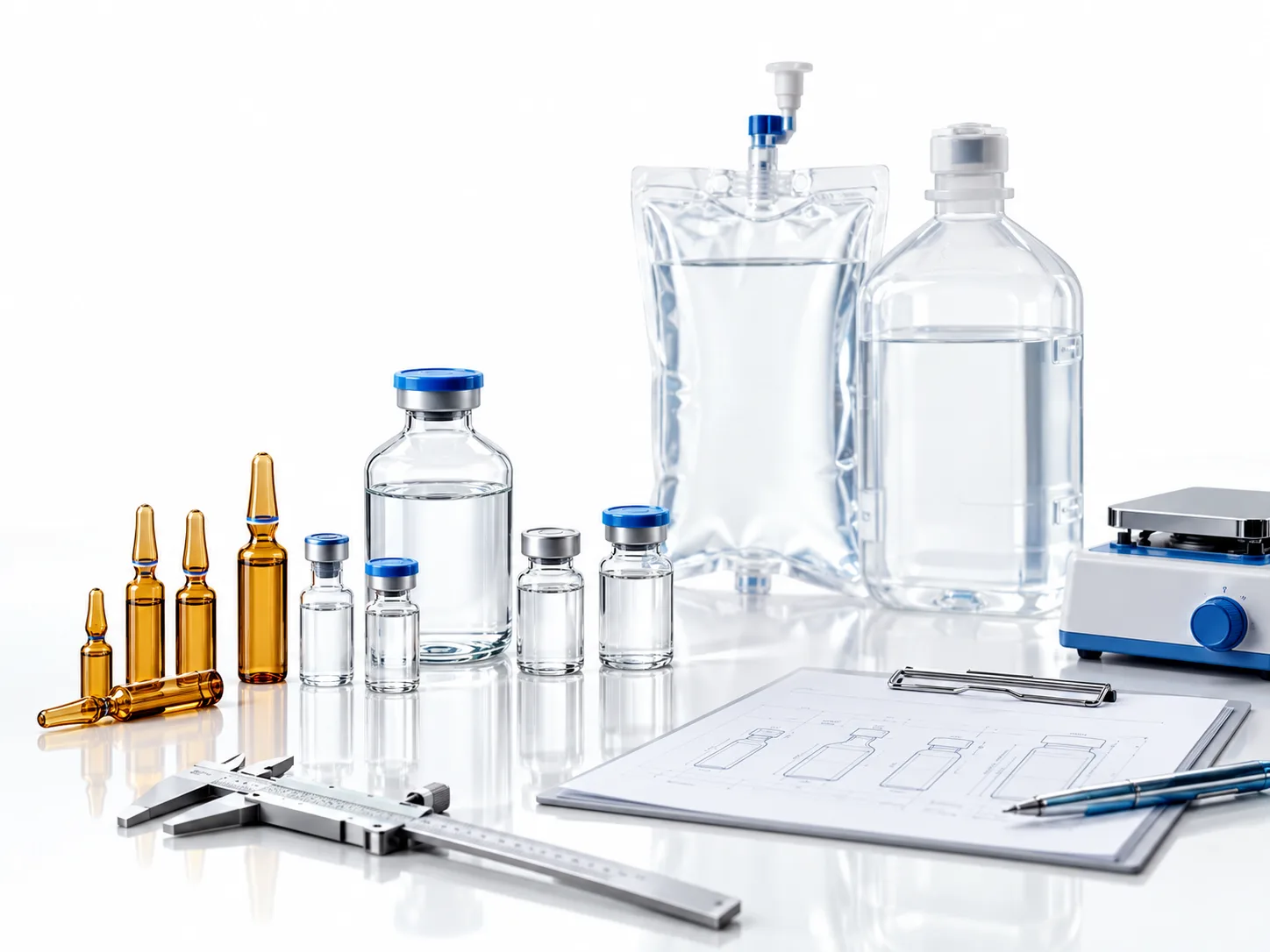
Chapter <650> distinguishes between small-volume and large-volume injectable preparations and describes specific conditions for performing the tests. Selecting the procedure requires consideration of the labeled volume, pharmaceutical presentation, and corresponding monograph.
For the light obscuration test, the chapter considers large-volume injectables to be those with a labeled volume equal to or greater than 100 mL. Preparations with a labeled volume below 100 mL are classified as small-volume injectables.
Labeled Volume and Sampling
For small-volume injectables containing less than 25 mL per unit, the light obscuration procedure allows the contents of ten or more units to be combined to obtain sufficient volume for testing.
The need to combine units highlights one of the challenges of analyzing reduced sample volumes. A study presented by INNOTEC on reducing sample volume in light obscuration particle analysis investigated how different volumes influence the analytical performance of the method.
For preparations containing 25 mL or more per unit, testing may be performed on individual units. Large-volume injectables must be tested as individual units.
The number of units analyzed must allow a statistically valid assessment when the objective is to characterize a batch. The chapter recommends that sampling plans consider historical particle counts, particle size distribution, and variability between units.
Formulations and Special Conditions
Multidose preparations, sterile powders, and lyophilized products require attention to specific preparation and calculation instructions.
The chapter also establishes particular applicability conditions and provides an exemption for injectables whose labeling states that the product must be used with filtration. This provision should not be generalized to other presentations.
Before testing, the general chapter, product monograph, and specific requirements applicable to the medicine must be reviewed.
2. Sample Preparation: Conditions That May Compromise Particle Counting

Particles originating from containers, handling materials, water used in testing, or the measurement system itself may interfere with the determination.
For this reason, Chapter <650> establishes cleaning procedures and controls for analytical conditions before sample counting.
Blank Control in the Light Obscuration Method
The procedure described in the Argentine Pharmacopoeia uses 50 mL of distilled or deionized and filtered water for blank verification.
After preparation and degassing, three consecutive counts are performed using portions of at least 5 mL. The first count is disregarded.
The chapter establishes the following criteria for the combined 10 mL sample corresponding to the two counts considered:
| Particle Size Class | Blank Acceptance Criterion |
|---|---|
| Particles ≥ 10 µm | Not more than 10 particles in 10 mL |
| Particles ≥ 25 µm | Not more than 2 particles in 10 mL |
If these values are exceeded, the chapter considers the conditions unsuitable for testing. Preparation must be reviewed and the checks repeated until appropriate conditions are achieved.
Homogenization and Bubble Removal
For preparations covered by the light obscuration procedure, the Argentine Pharmacopoeia describes inverting the container twenty times to resuspend particles.
Bubbles may be removed by sonication for approximately 30 seconds or by allowing the sample to stand, according to the conditions described in the chapter.
The sample must be handled carefully to prevent the introduction of additional particles or bubbles before counting.
Aliquots and Actual Analyzed Volume
The pharmacopoeial light obscuration procedure uses at least three aliquots, each with a volume of no less than 5 mL. The first count is discarded, and the remaining results are used in the calculations.
For pooled samples, the total volume must be sufficient to meet the preparation and testing conditions established in the chapter.
It is important to distinguish the minimum volume required by the pharmacopoeial procedure from an instrument's ability to work with smaller volumes under other analytical methods.
3. Acceptance Limits for 10 µm and 25 µm Particles
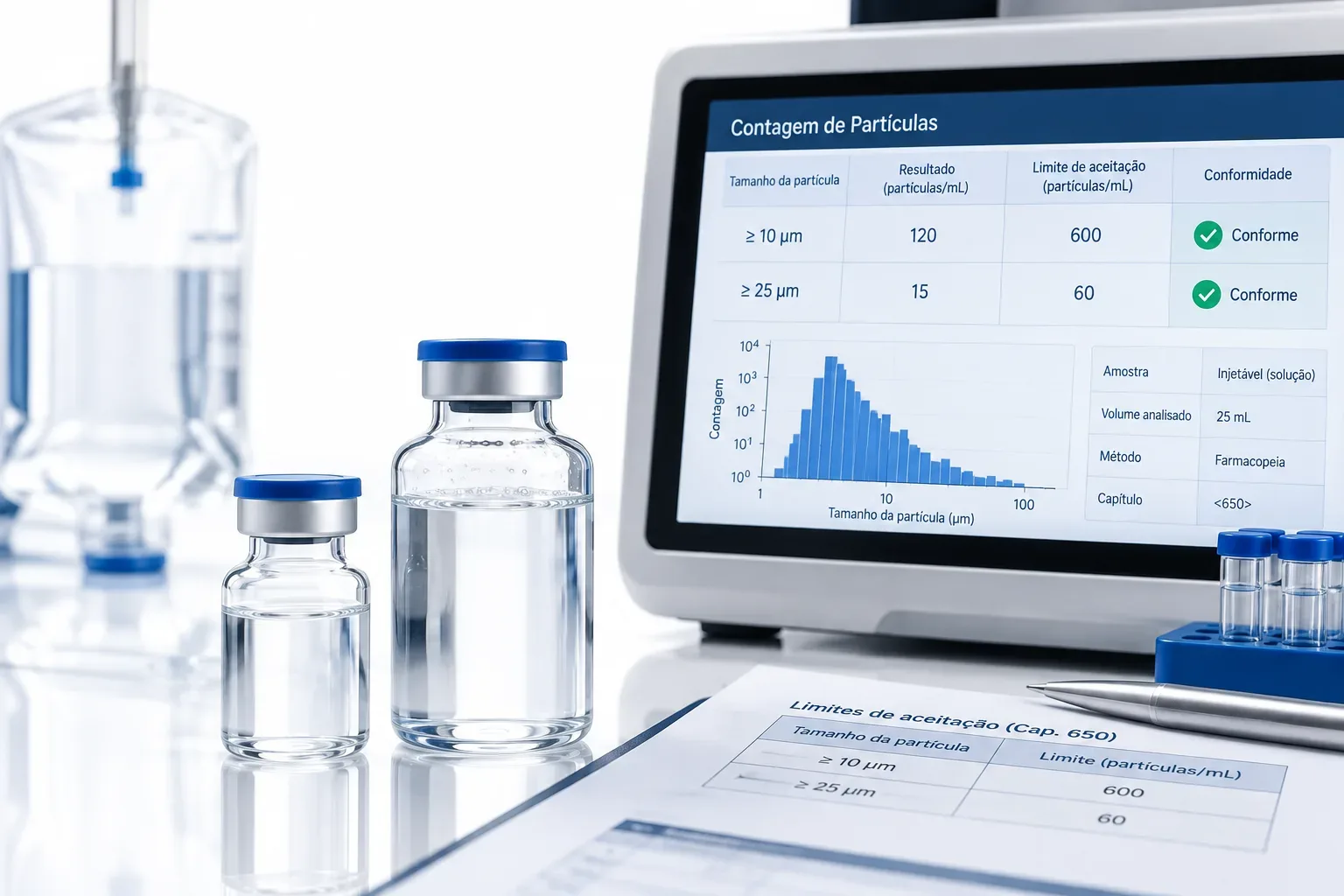
Chapter <650> establishes acceptance criteria for particle size classes equal to or greater than 10 µm and equal to or greater than 25 µm.
The limits vary according to the method used and whether the preparation is classified as a small-volume or large-volume injectable.
Acceptance Limits for Light Obscuration Counting
Table 1 of Chapter <650> establishes the following maximum limits:
| Preparation | ≥ 10 µm | ≥ 25 µm |
|---|---|---|
| Small-volume injectables | 6,000 particles/unit | 600 particles/unit |
| Large-volume injectables | 25 particles/mL | 3 particles/mL |
Acceptance Limits for Microscopic Counting
For the microscopic counting procedure, Table 2 of the chapter establishes limits different from those applicable to light obscuration.
| Preparation | ≥ 10 µm | ≥ 25 µm |
|---|---|---|
| Small-volume injectables | 3,000 particles/unit | 300 particles/unit |
| Large-volume injectables | 12 particles/mL | 2 particles/mL |
The values presented correspond to the official tables in Chapter <650>, available through the Argentine Republic's legislation portal.
Criteria established for one method must not be applied to results obtained using the other. The product monograph and any specific requirements must also be verified.
4. Calculation and Reporting of Results: Where Can Interpretation Errors Occur?

Instrumental results must be converted into the units required by the pharmacopoeial procedure.
A count obtained from a 5 mL aliquot does not automatically represent the particle count per container or per milliliter of the preparation.
Small-Volume Preparations
For pooled samples, the result per unit depends on the average of the counts considered, the total volume of the mixture, the volume of each aliquot, and the number of units pooled.
For individual units, the calculation considers the average count and the relationship between the unit volume and the volume actually analyzed.
Large-Volume Preparations
For large-volume injectables, the average count is divided by the volume of the analyzed aliquot, yielding the result in particles per milliliter.
Multidose Presentations
The chapter establishes that the result must account for the volume corresponding to the maximum dose stated on the label, following the applicable calculation instructions.
The laboratory must ensure that calculations performed by software or result spreadsheets correctly reproduce the conditions of the adopted procedure.
5. Limitations of Light Obscuration: When Should Microscopy Be Considered?
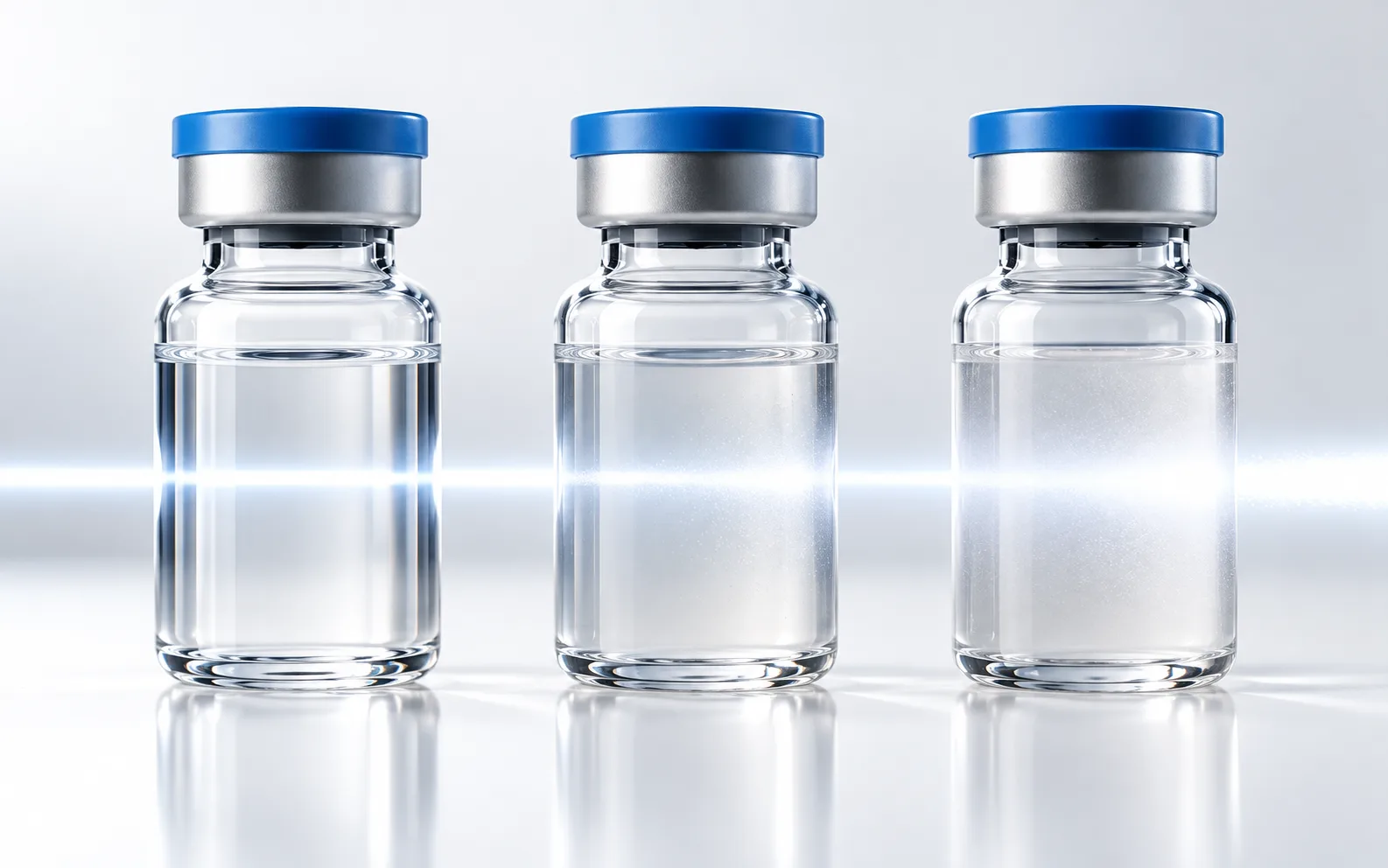
Light obscuration is the procedure initially described in Chapter <650> for evaluating formulations to which the method applies.
However, certain sample characteristics may compromise the suitability of the technique.
Transparency, Viscosity, and Matrix Characteristics
The chapter warns that products whose transparency or viscosity differs from that of water may produce incorrect results when analyzed by light obscuration.
In certain situations, the microscopic procedure may be used. When viscosity prevents proper testing, the chapter also allows quantitative dilution with an appropriate diluent.
In such cases, dilution must be accounted for when determining the final result.
Particle Concentration and Sensor Limitations
Sensor selection must consider its concentration limit and dynamic measurement range.
The chapter establishes that the concentration limit certified by the manufacturer must be greater than the particle concentration of the sample being analyzed.
The simultaneous presence of particles in the detection region may cause pulse coincidence and compromise counting accuracy. Therefore, operating within the conditions specified for the sensor is essential for analytical reliability.
Results Exceeding the Light Obscuration Limit
The chapter describes proceeding to microscopic testing when the formulation does not meet the light obscuration specifications.
The microscopic method involves collecting particles on a filter membrane and evaluating them according to specific criteria. The procedure excludes certain amorphous, semiliquid, or film-like materials, as described in the Pharmacopoeia.
This means that the methods are not analytically identical, and their results should not be considered interchangeable.
An out-of-specification result must also be handled according to the laboratory quality system's procedures for investigating deviations and out-of-specification results.
6. HIAC 9703+: Instrumental Application in Subvisible Particle Control
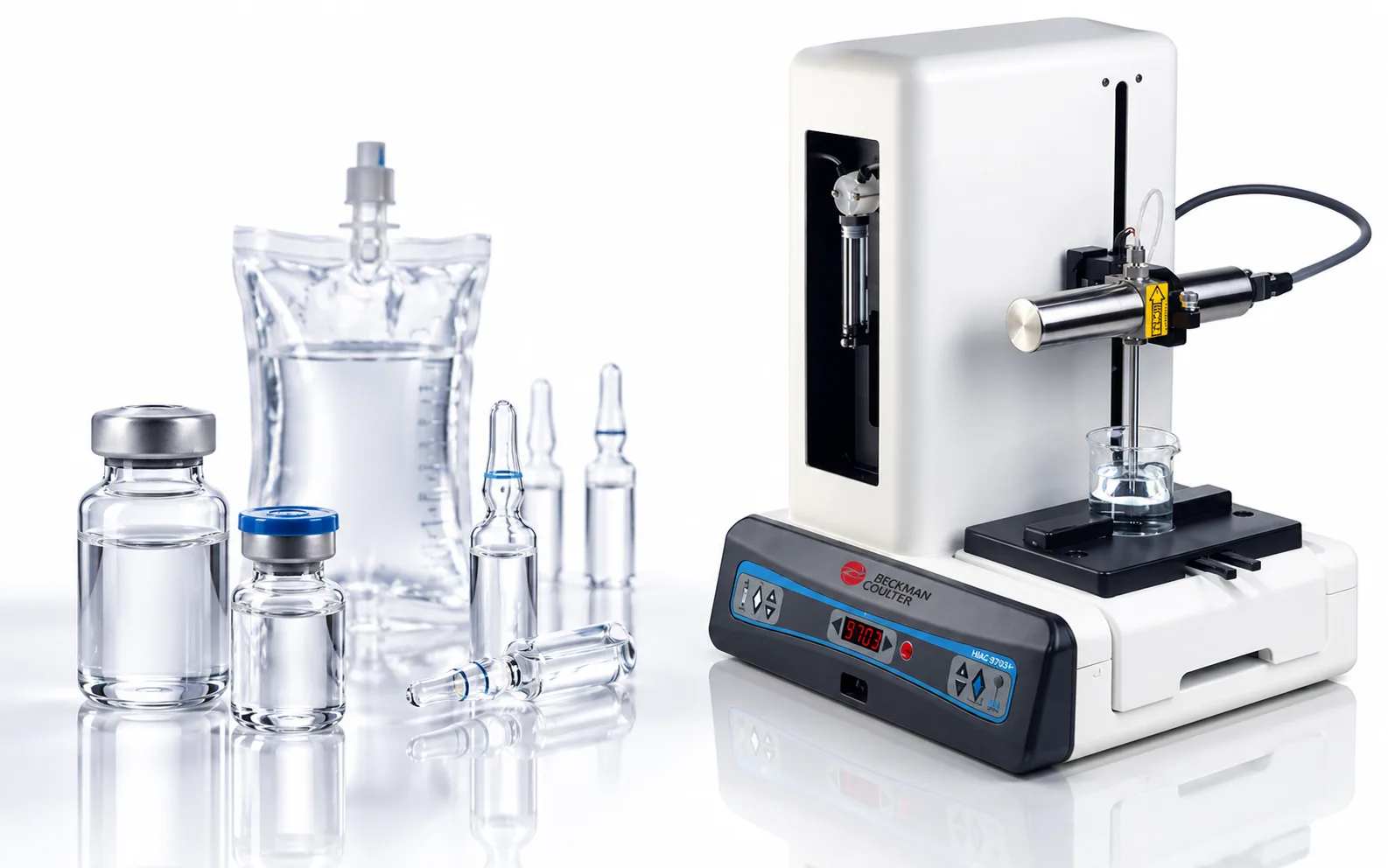
The HIAC 9703+ , manufactured by Beckman Coulter, is a liquid particle counting system developed for pharmaceutical applications, including the analysis of parenteral products.
The instrument uses optical light obscuration sensors and can be integrated with PharmSpec software for test execution, data acquisition, and result management.
Sensor Selection and Operating Conditions
The HIAC 9703+ supports different sensor configurations from the HRLD family, each with specific detection ranges.
For testing, selection must consider the required particle size classes, preparation characteristics, sensor concentration limit, and operating conditions.
The sensors and parameters used must be appropriately qualified and calibrated for the intended application.
Supported Pharmacopoeial Procedures
Beckman Coulter reports that the HIAC 9703+ with PharmSpec supports the light obscuration methods described in:
- USP <787> : Determination of subvisible particles in therapeutic protein injections.
- USP <788> : Particulate matter in injections.
- USP <789> : Particulate matter in ophthalmic solutions.
- European Pharmacopoeia 2.9.19 : Subvisible particulate contamination.
These capabilities are relevant to laboratories working with different compendia. However, applying Argentine Chapter <650> requires verifying the correspondence between the procedures, criteria, and calculations used.
Reduced Sample Volume: Instrument Capability and Pharmacopoeial Requirements
The HIAC 9703+ offers capabilities for analyzing reduced product volumes, depending on the configuration and procedure used.
However, the fact that an instrument can perform analyses using 1 mL does not automatically change the volume specified in Argentine Chapter <650>.
The use of smaller volumes must be evaluated within the specific method, considering analytical suitability and applicable regulatory requirements.
Traceability and Data Integrity with PharmSpec
PharmSpec software provides access control, user authentication, audit trail records, and protected data storage capabilities.
According to Beckman Coulter, these functionalities support the implementation of requirements related to data integrity and 21 CFR Part 11 .
The software also enables the configuration of test procedures and automated result evaluation routines, including calculation and compliance classification capabilities according to the modules used.
The availability of these functionalities does not eliminate the need for computerized system qualification, permission management, procedure validation, and quality system controls.
Manufacturer documentation: PharmSpec Software for HIAC 9703+ .
7. Analytical Documentation: What Evidence Supports Test Compliance?

In routine quality control, compliance depends not only on the final result but also on the evidence demonstrating that the method was properly performed.
This evidence must make it possible to reconstruct the analytical conditions, verify calculations, and identify potential deviations.
The following table organizes relevant aspects for reviewing the analytical procedure and its records. It is a technical support matrix, not an official checklist issued by ANMAT.
| Aspect | Technical Verification |
|---|---|
| Regulatory reference | Applicable chapter, edition, supplements, and monograph. |
| Sampling plan | Number of units and statistical justification. |
| Sample preparation | Volume, homogenization, dilutions, and contamination prevention. |
| Blank control | Results and compliance with established criteria. |
| Measurement system | Sensor, dynamic range, calibration, and qualification. |
| Results | Counts considered, calculations, units, and applied limits. |
| Data integrity | Original records, traceability, reviews, and change control. |
| Deviations | Investigation, technical justifications, and documentation of decisions. |
Chapter <650> provides the basis for the analytical procedure, but execution in a regulated pharmaceutical environment also depends on operating procedures, qualification practices, and responsibilities established within the quality system.
Conclusion: Compliance Depends on Correct Method Application
Determining subvisible particles in injectable medicines requires attention to procedure applicability, sample preparation, instrumental limitations, and reporting of results.
Chapter <650> of the Argentine Pharmacopoeia provides specific criteria for light obscuration and microscopic counting. Its application requires verification of the preparation's characteristics and the suitability of the procedure for the product being analyzed.
Systems such as the HIAC 9703+ from Beckman Coulter can be integrated into these quality control workflows, providing instrumental capabilities for liquid particle counting and tools for managing analytical data.
INNOTEC is the exclusive distributor of the Beckman Coulter particle counting product line in Argentina, providing technical information about the HIAC 9703+ and its applications in pharmaceutical laboratories.
Explore the HIAC 9703+ in the INNOTEC catalog.