

The advancement of carbon capture technologies is essential to reduce industrial emissions and meet the goals of the Paris Agreement. In this study, a metal-organic framework (MOF) developed by novoMOF AG demonstrated excellent performance in CO₂ capture even in high humidity environments — a common challenge in post-combustion capture .
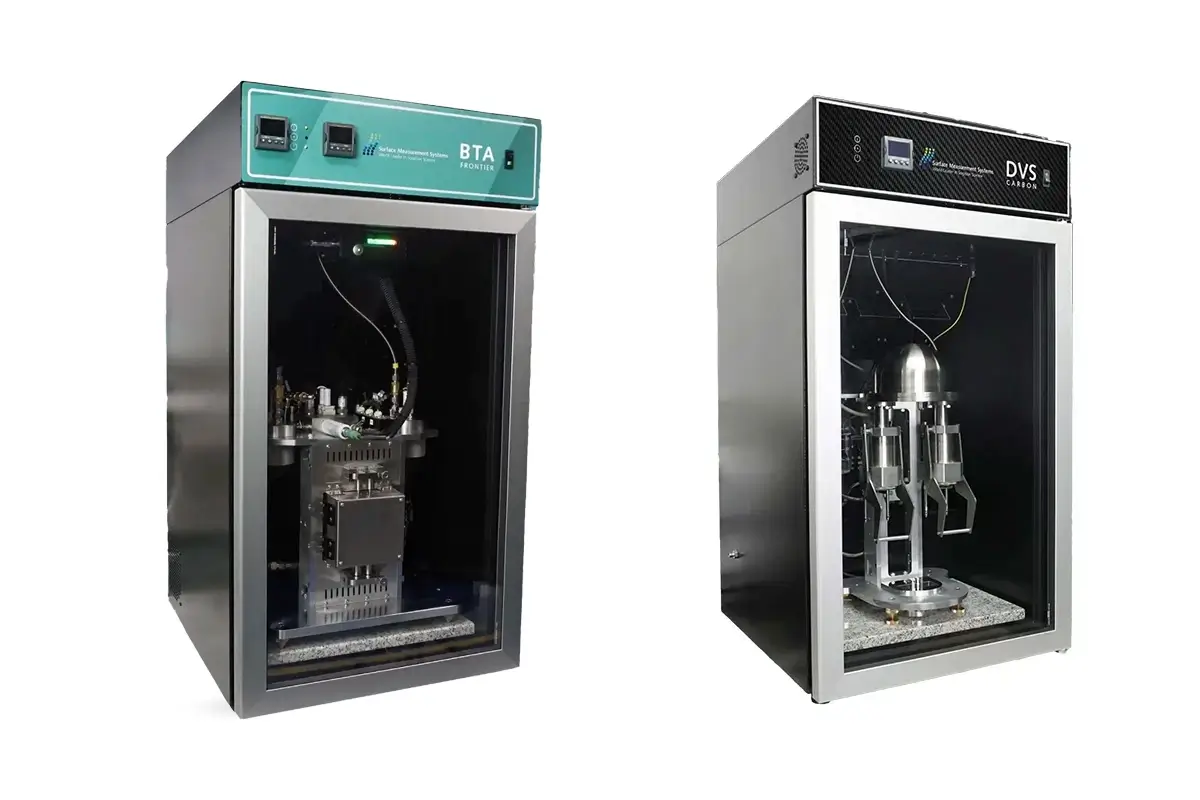
Using the equipment DVS Carbon and BTA Frontier from Surface Measurement Systems , the study analyzed the co-adsorption of carbon dioxide and water vapor in a precise and realistic way, paving the way for new sustainable solutions in gas capture materials .
The Challenge of CO₂ Capture in Humid Environments
Humidity is one of the main obstacles for carbon capture technologies. It interferes with CO₂ adsorption, reducing the efficiency of many materials. MOFs (metal-organic frameworks) emerge as a promising alternative, thanks to their porous structure and chemical stability.
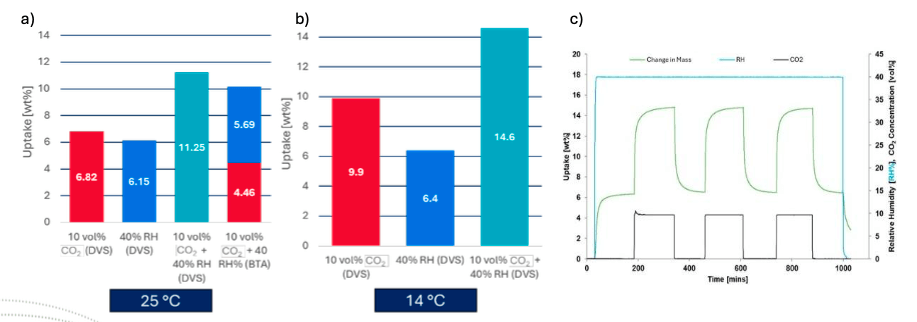
The MOF analyzed in the study demonstrated high CO₂ adsorption capacity and stability after multiple cycles, even under 50% relative humidity. This makes it ideal for post-combustion industrial applications.
Methodology Used
The powder samples were evaluated with the DVS Carbon to determine the gravimetric adsorption of CO₂ and H₂O, while the pelletized version was analyzed with the BTA Frontier for dynamic co-adsorption tests. Measurements took place between 14 °C and 40 °C, simulating real industrial gas conditions.
Learn more about the BTA Frontier by clicking here
fig1-dvs-carbon-bta-frontier
- High thermal precision: ±0.01 °C;
- Weighing sensitivity: 0.01 μg;
- Total flow: 200 sccm with controlled mixture of N₂, CO₂ and H₂O vapor.
Main Results of the MOF for CO₂ Capture
The results showed excellent performance of the MOF, with fast adsorption kinetics and high stability over multiple cycles. Below, the numerical highlights:
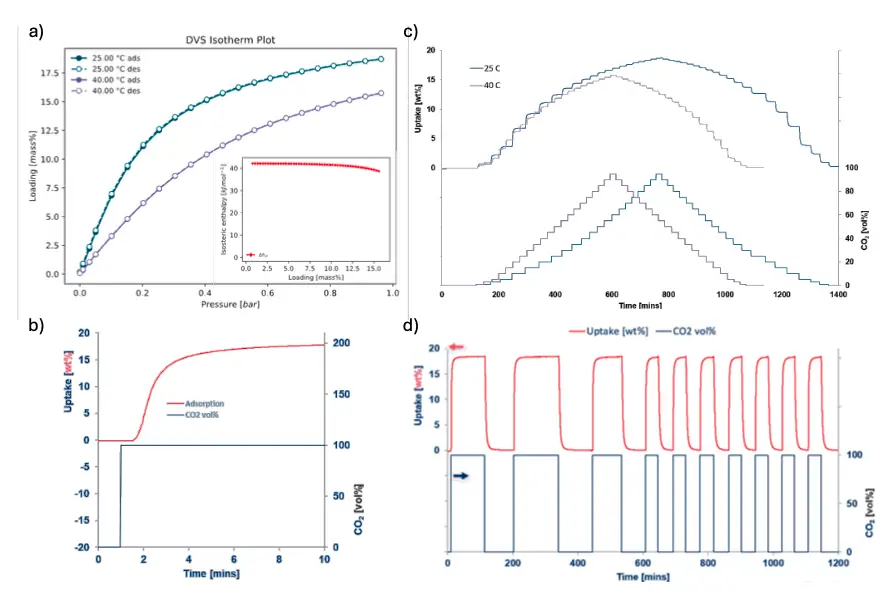
- 18.71 wt% of CO₂ at 25 °C and 0.95 bar;
- 9.28 wt% at 15 vol% CO₂ (typical industrial conditions);
- Adsorption energy between 38.6 and 42.1 kJ/mol — ideal for efficient regeneration;
- Stability after 10 cycles of adsorption and desorption.
In addition to CO₂ analysis, the material's behavior in the presence of humidity was examined with the DVS Carbon. The graph below shows H₂O sorption at different temperatures, highlighting the MOF's stability in humid environments.
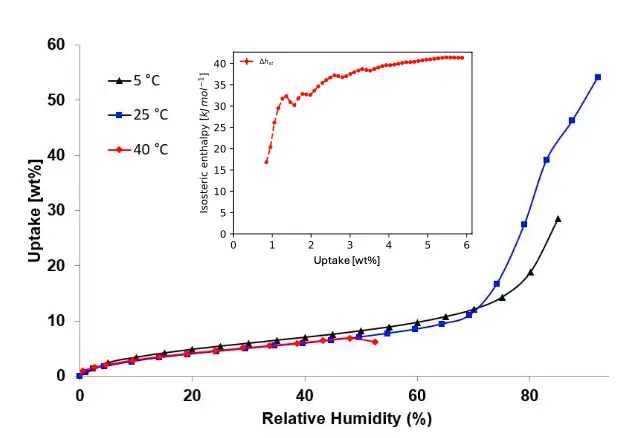
Figure 3.
H₂O sorption isotherms revealing low water absorption and thermal stability.
fig3-sorcao-h2o
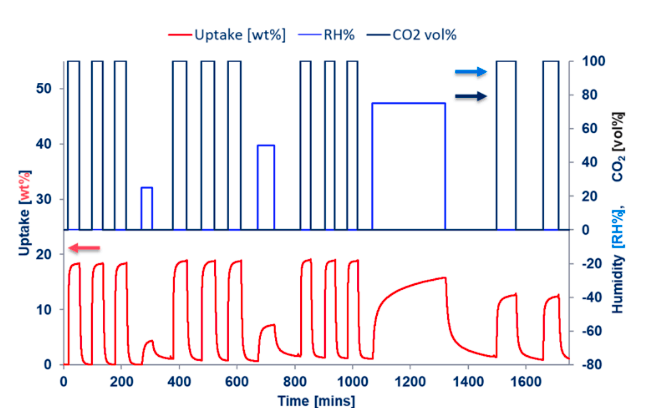
Even under 40% humidity, the MOF maintained constant performance and no competition between CO₂ and H₂O, indicating a non-interactive adsorption behavior — a rare and advantageous characteristic in industrial processes.
Co-adsorption and Breakthrough Analysis
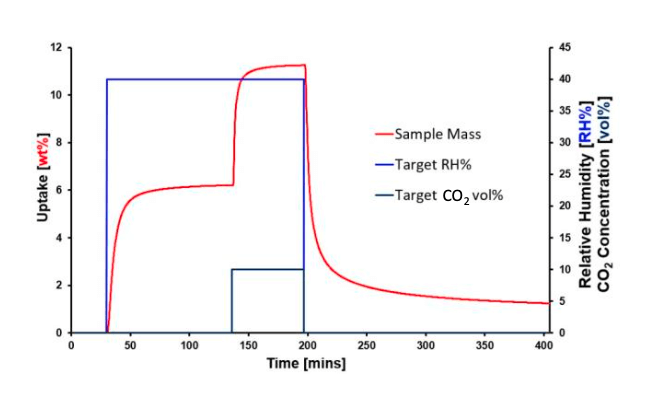
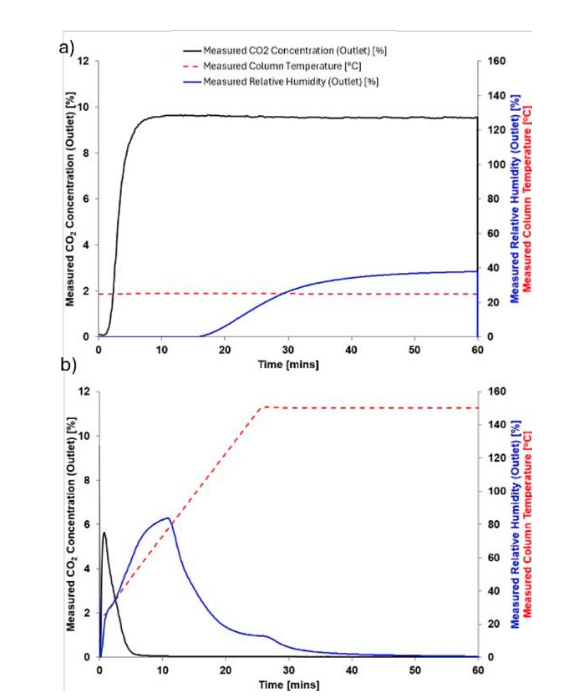
The BTA Frontier confirmed that the MOF simultaneously retains CO₂ and H₂O without significant performance loss. During the tests, co-adsorption showed a total mass of 11.25 wt% , with no competitive substitution between the gases. This indicates that the material can operate stably in humid gas streams , without the need for prior dehumidification.
Comparison with Reference Materials
Compared to other sorbents, such as CALF-203 and MUF-166, the new MOF showed higher capture capacity and regeneration ability , maintaining superior performance even under 75% RH, a condition that typically degrades conventional materials.
Environmental and Technological Impact
Combining the DVS Carbon and BTA Frontier technologies, the study enabled precise and accelerated measurements for the development of advanced CO₂ capture materials . This integrated approach is fundamental to accelerating climate mitigation solutions and the transition to a low-carbon economy.
The study reinforces that MOFs with stability in the presence of humidity are key pieces for the next generation of sustainable carbon capture technologies.
Conclusion
The MOF developed by novoMOF proved to be highly efficient in capturing CO₂ in humid streams , maintaining exceptional capacity and stability. The combination of the DVS Carbon and BTA Frontier instruments offers a comprehensive method for sorbent evaluation, directly contributing to the advancement of carbon capture technologies.
Frequently Asked Questions (FAQ)
What is a MOF?
MOF (Metal–Organic Framework) is a highly porous crystalline material formed by metal ions and organic linkers, used to capture and store gases like CO₂.
Why study the co-adsorption of CO₂ and H₂O?
Because water vapor interferes with CO₂ capture in real processes. Understanding this behavior is essential to develop efficient materials under humid conditions.
What differentiates the DVS Carbon and the BTA Frontier?
The DVS Carbon measures gravimetric adsorption with high precision, while the BTA Frontier simulates real gas flows, evaluating the dynamic performance of sorbents.
Can this MOF be used on a large scale?
Yes. The material showed stability and performance compatible with post-combustion industrial applications.
What is the environmental benefit of this type of study?
It contributes to the development of technologies that reduce CO₂ emissions, supporting global sustainability goals and climate warming mitigation.
Who conducted the study?
The work was conducted by Surface Measurement Systems Ltd. in collaboration with novoMOF AG , using the DVS Carbon and BTA Frontier equipment.