Purchase of scientific equipment as a strategic action
After closely following acquisitions that turned into results, and others that ended up sitting on the bench, I learned that the biggest factor isn't the amount on the invoice.
The purchase of scientific equipment is the decision to acquire high-tech instruments for academic, industrial or institutional laboratories, considering not just the price, but the actual application, the technical specifications and the capacity to deliver results.
Programs such as the Multiuser Equipment Program (EMU) from FAPESP treat this acquisition as a strategic research infrastructure decision, not as a simple administrative purchase.
The topic has gained weight because the cost of instruments has grown in recent decades. When launching a R$ 70 million call for scientific equipment acquisition , FAPESP highlighted that many of these instruments now need to be used by multiple research groups at different times, a sign that buying well has become as difficult as securing the funding.
Here I bring together what I've learned in nearly 30 years of experience with scientific equipment.
- What to evaluate before the purchase of scientific equipment ;
- Why the price does not represent the total cost of ownership;
- Technical specification and compatibility with the method;
- Infrastructure and installation often forgotten in the budget;
- Training, technical support and continuity after installation;
- Underutilization: when the right equipment becomes idle assets;
- How to conduct the purchase decision consistently.
What to evaluate before purchasing scientific equipment
Securing the funding is difficult, but turning that funding into results is the real challenge. In many projects, the discussion focuses only on price, the purchasing process and resource availability.
A high-tech instrument, however, carries variables that don't appear in the quotation. The decision needs to start with the laboratory's actual application and the central question: what scientific problem does this equipment solve?
In science, buying the wrong equipment can be just as harmful as not being able to buy any equipment at all.
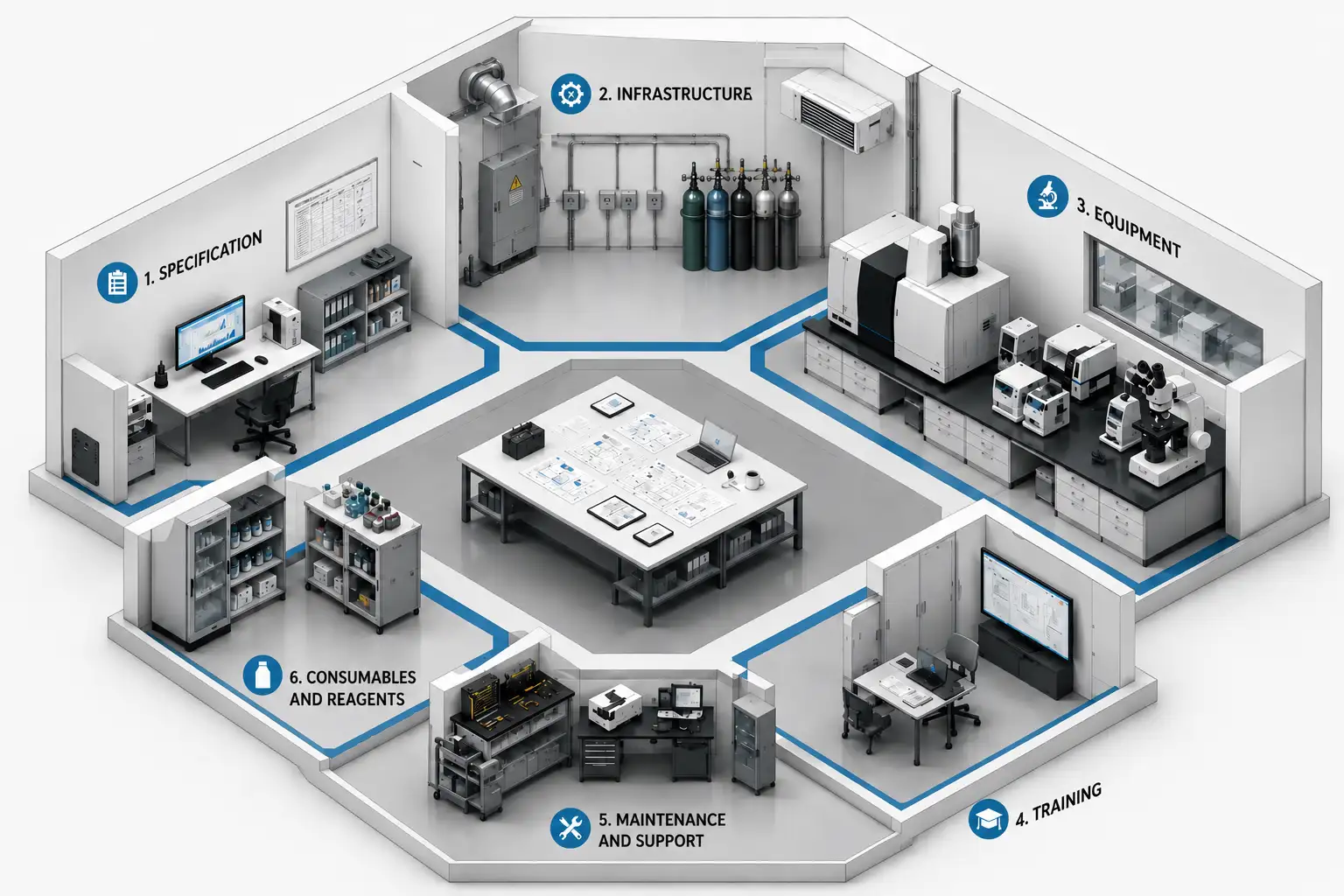
Before closing the purchase of scientific equipment , it's necessary to understand the intended application, the correct technical specification, compatibility with the desired methods, installation infrastructure, training availability, local technical support, and access to parts, consumables and service assistance.
Price is not cost: the total cost of ownership of scientific equipment
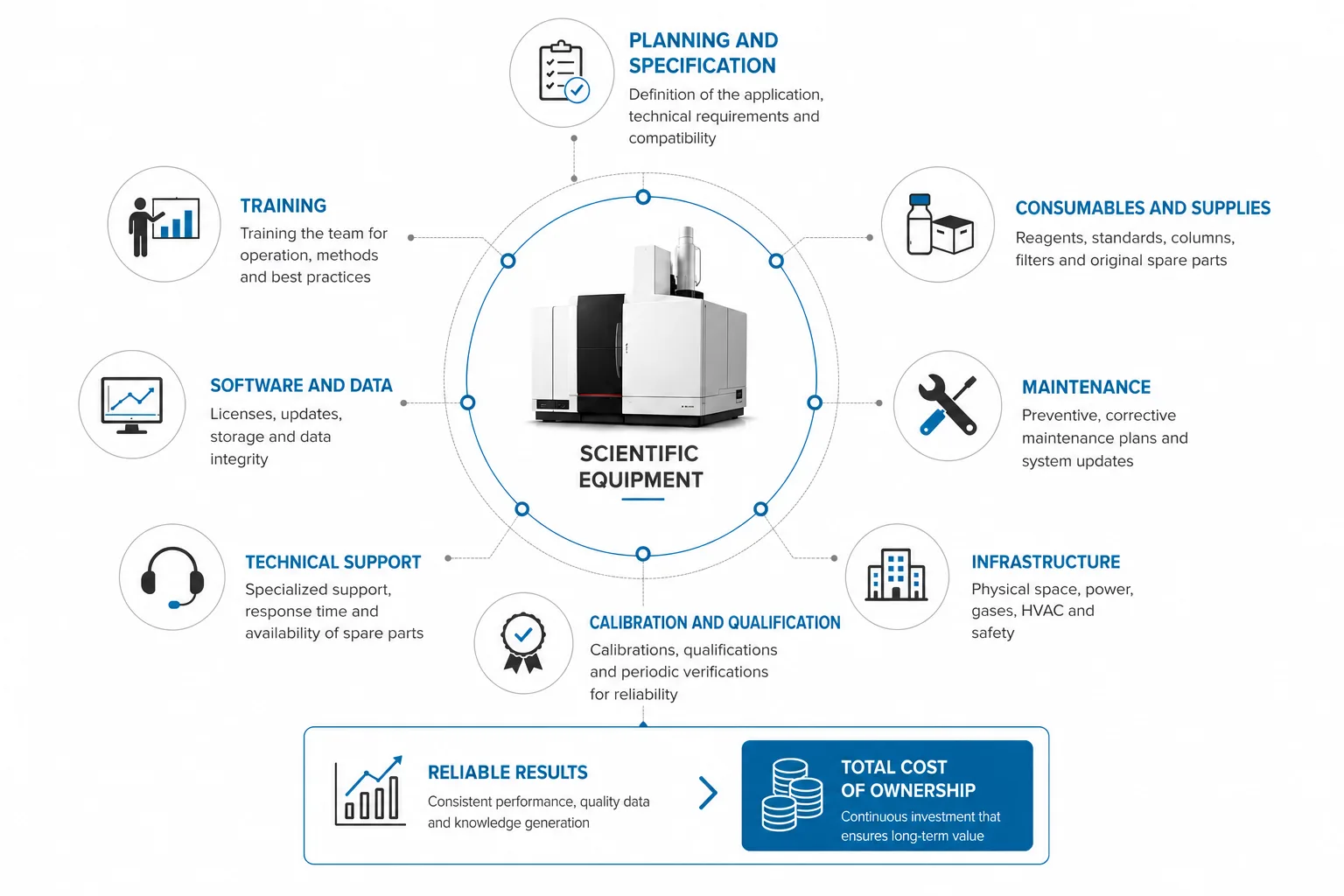
The most common mistake is treating the invoice value as the cost of the equipment. The purchase price is usually just the first installment of a cost that extends over years.
Installation, calibration, proprietary consumables, maintenance contracts, downtime, operator training and disposal are all part of the so-called total cost of ownership.
Ignoring these items in the planning tends to generate unforeseen expenses throughout the equipment's useful life.
The very logic of multiuser programs recognizes this. In FAPESP's model, the institution receiving the equipment assumes, for seven years, the counterpart of infrastructure, insurance and technical support staff, a formal acknowledgment that the purchase is only the beginning of the financial commitment.
The cheapest equipment in the quote can become the most expensive over its useful life.
Technical specification and compatibility with the method
Much of the failures in the purchase of scientific equipment are born before delivery, during specification. An instrument that looks adequate on paper may not meet the analytical method the laboratory needs to perform.
Operating range, sensitivity, detection limits, software, integration with existing systems and compatibility with consumables define whether the equipment will actually deliver the expected data.
A generic or rushed specification often results in incompatibility with the application.
Studies on research infrastructure show that shared facilities concentrate advanced equipment and technical expertise that isolated groups would hardly be able to maintain . This reinforces a practical point: the correct specification depends on those who know the method, not just those who manage the purchase.
Infrastructure and installation: what the budget usually forgets
Many equipment require specific conditions to operate within specifications. Without this preparation, the instrument arrives but does not operate reliably.
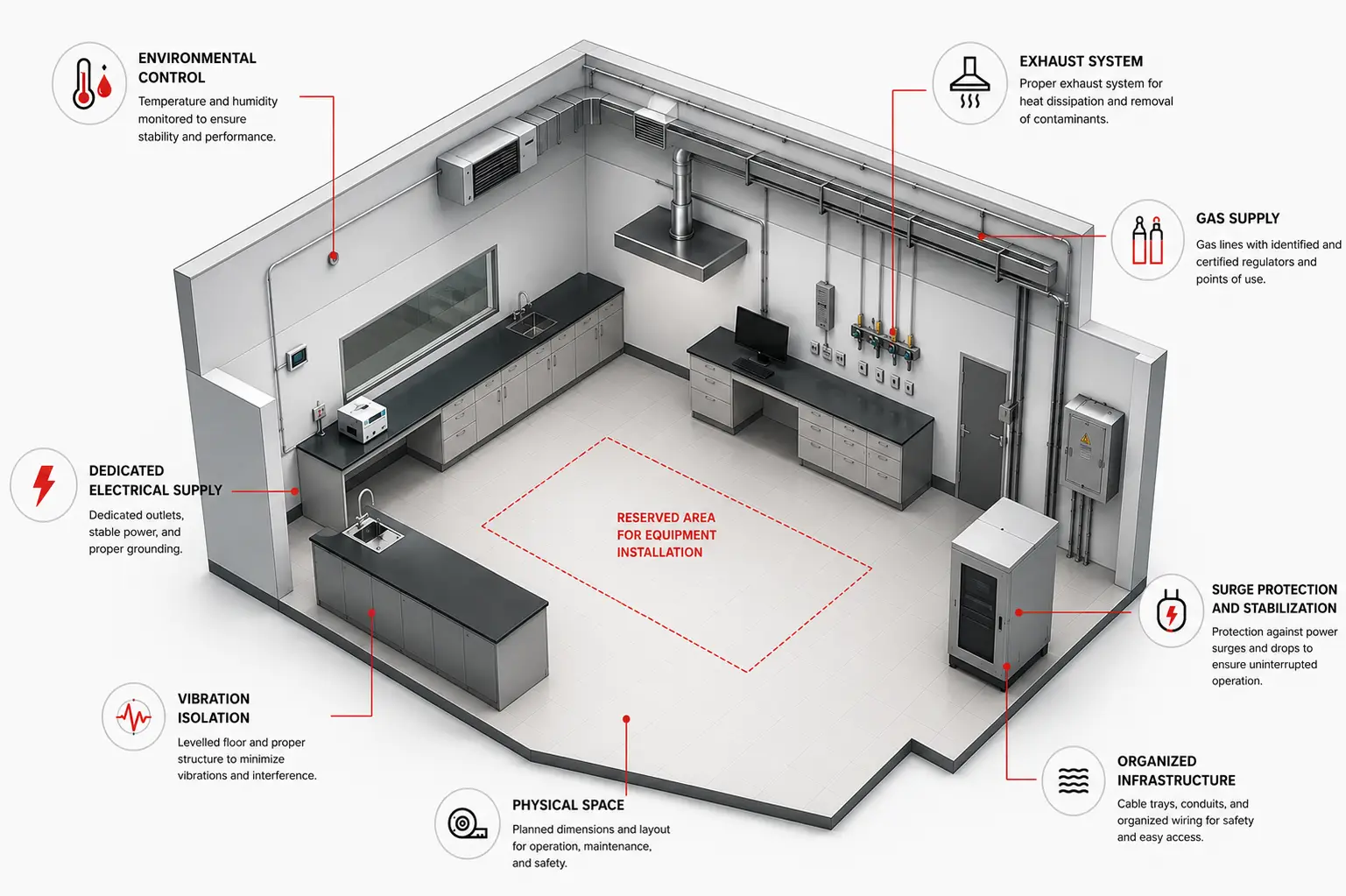
Temperature and humidity control, vibration isolation, adequate electrical supply, gas supply, exhaust and physical space are common requirements for high-sensitivity scientific equipment . When these items are not included in the planning, last-minute retrofits and project delays arise.
That's why institutional programs require, before releasing the funds, a document guaranteeing space and installation conditions compatible with the research timeline. Infrastructure ceases to be a detail and becomes a purchase condition.
Training, technical support and continuity after installation
After installation, the equipment only delivers value if there are people who know how to operate and maintain it. Here lies one of the most neglected parts of the purchase of scientific equipment . The availability of training, local technical support and access to parts and service determine the continuity of operations. An instrument that depends on difficult-to-access external support tends to accumulate downtime and compromise projects.
The literature on best practices in research facilities treats user training and certification as part of data quality, not as an incidental cost. EMBO reports describes core facilities as knowledge hubs where structured training sustains the reliability of results.
This dedicated expertise makes a difference. The think tank Ithaka S+R points out that research cores bring together specialized technical teams to operate complex instruments, something individual laboratories rarely manage to maintain on their own.
Without nearby training and support, even the best instrument becomes an expensive and unproductive resource.
Underutilization: when the right equipment becomes idle assets
The worst outcome of a purchase of scientific equipment is not the equipment breaking down. It's the equipment arriving, working and then sitting idle. Underutilization transforms investment into idle assets.
A study published in eLife on core facilities reports that research resources are wasted and reproducibility suffers when there is a failure in communication and alignment between those who operate the instrument and those who use it. The problem is often not technical, it's about planning and usage.
The institutional response to this is sharing. The University of Colorado Boulder program converts underutilized equipment into shared resources , avoiding duplicate purchases and expanding the use of what already exists on campus.
The Brazilian model follows the same logic. When structuring the EMU, FAPESP took care to avoid redundancies, so that identical or similar instruments would not be installed in the same region and end up sitting idle.
The management of this usage is usually conducted by a steering committee and a user commission, as described in the literature on operational and fiscal management of shared facilities .
Conclusion: How to conduct the purchase of scientific equipment consistently
The choice of a scientific technology should not fall on a single person or on the isolated criterion of price. It needs to bring the right roles together around the same decision.
A well-conducted purchase of scientific equipment typically involves:
- Researchers and end users, who know the application and the method;
- Technical specialists, responsible for specification and infrastructure;
- Qualified suppliers, with proven support, training and service;
- Institutional management, attentive to total cost and operational continuity.
With these roles aligned, the decision ceases to be administrative and becomes scientific. Price still matters, but application, support, training, continuity and results matter even more.
The best equipment is not the cheapest or the most sophisticated it's the one that solves the scientific problem and continues to deliver value after installation.
Innotec: partner in the purchase of scientific equipment with support and training
Innotec acts in the stages that often define investment success: support in the correct technical specification for the desired method, technical support and user training, the points that, as seen throughout this content, reduce the risk of underutilization and downtime.
Here you count on technicians with over 30 years of experience , technical assistance, training and real-world application and usage experience, the complete structure to support the selection, purchase, use and maintenance of your scientific equipment.
Having close technical knowledge, from budgeting to operation, is what transforms purchase into laboratory results.
By bringing together a portfolio of scientific equipment, guidance in selection and assistance after installation, Innotec helps the laboratory decide based on application and continuity, not just on price.
Contact Innotec: info@innoteclatam.com
Related reading
- Total cost of ownership of laboratory equipment
- Multiuser equipment and shared research facilities
- Technical specification of analytical instruments