

Typically, the last page of any analytical instrument's datasheet presents a multitude of specifications. Air Particle Counters (APC) are no different. Many of the parameters used to define the performance of an APC are relatively easy to understand, such as flow rate . Others, like coincidence loss , are much less intuitive.
In this article, you will find:
-
A complete explanation of what counting efficiency is;
-
How the calibration process for an Air Particle Counter is done according to the ISO 21501-4 standard;
-
The relationship between counting efficiency and particle monitoring in controlled environments;
-
The importance of correctly interpreting particle counter technical specifications.
-
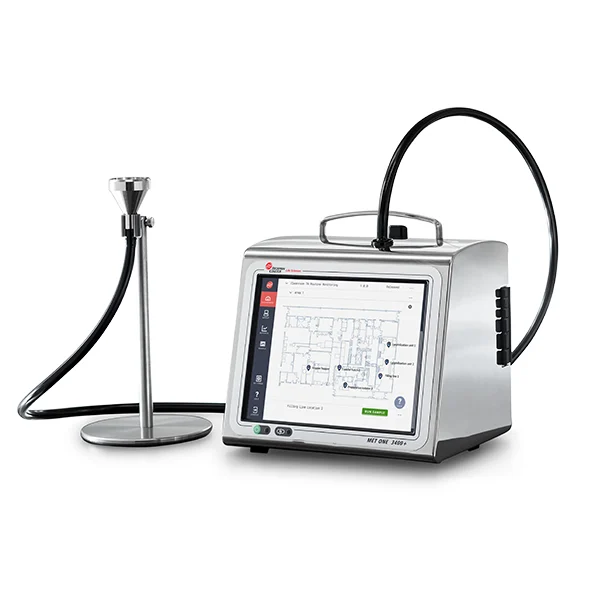
And get to know the MET ONE 3400+ Air Particle Counter
What exactly is Counting Efficiency?
To understand the counting efficiency of an Air Particle Counter, one must first examine the basic principle behind its calibration:
-
A continuous flow of standard particles, of single, known size, passes through the Air Particle Counter sensor.
-
Each particle generates an electrical pulse proportional to its size.
-
The single-sized particles generate a distribution of pulse heights, whose median value is typically considered the appropriate calibration threshold for that size.
Standard particle distribution and median calibration threshold
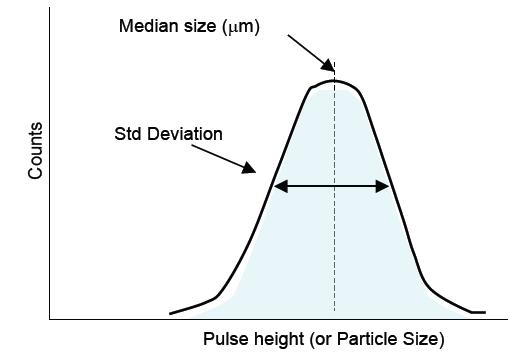
Figure 1. Single-size standard particle distribution and median calibration threshold
When calibrating an Air Particle Counter this way:
-
A particle exactly the same size as a channel's counting threshold will have a 50% probability of being counted.
-
Thus, APCs calibrated by this method have, by definition, a counting efficiency of 50% .
-
For particles larger than the channel threshold, the counting probability quickly rises to 100% .
Particles larger than the threshold are counted with 100% efficiency
Figure 2. Particles larger than the channel size threshold are all counted with 100% efficiency
In practical terms , when examining the datasheet of an Air Particle Counter compliant with ISO 21501-4, with a minimum sensitivity of 0.3 μm, you should expect to find something like:
Counting Efficiency: 50% ± 20% at 0.3 μm, (100% ± 10% at 1.5X the minimum sensitivity)
Attention!
Without understanding the concept of counting efficiency, one might mistakenly think the Air Particle Counter will count only half of the 0.3 μm particles in a real sample.
This is not true!
-
All particles larger than 0.3 μm will be counted.
-
It is also incorrect to assume the next channel (e.g., 0.5 μm) automatically has 100% efficiency.
Important fact:
And, for particles larger than each channel's threshold , detection will be 100% efficient .
Counting Efficiency and Particle Monitoring
As mentioned, the calibration of an Air Particle Counter involves the continuous flow of single-size standard particles through the sensor.
Correctly adjusted threshold for an Air Particle Counter with minimum sensitivity of 0.3 μm
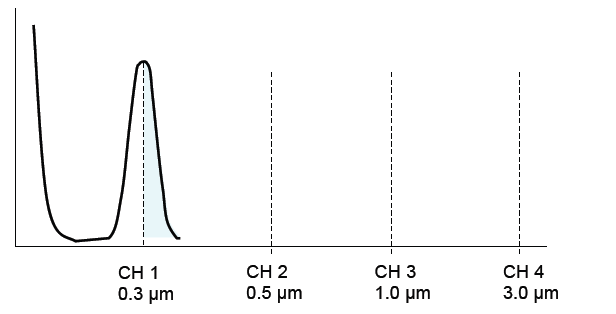
Figure 3. Correctly adjusted threshold for an Air Particle Counter with minimum channel size of 0.3 μm
In this case:
-
The first channel of the APC is adjusted to the mean of the 0.3 μm particle distribution.
-
This is called the 50% point and underpins the statement that counting efficiency is 50% .
All channels calibrated according to ISO 21501-4 exhibit 50% counting efficiency
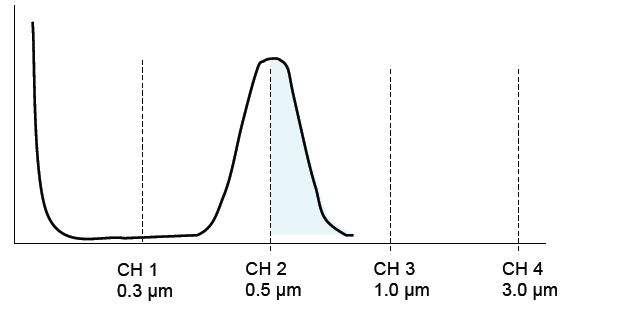
Figure 4. All channel thresholds adjusted to the mean of standard particles according to ISO 21501-4 exhibit 50% counting efficiency, regardless of the minimum channel size
Important observations:
-
An ISO 21501-4 compliant APC has narrow resolution , making it easy to distinguish between 0.3 μm and 0.5 μm particles.
-
Thus, all 0.5 μm particles will be identified as larger than the 0.3 μm threshold.
-
Therefore, 0.5 μm particles will be counted with 100% efficiency in the first channel (0.3 μm), not in the 0.5 μm channel.
Typical airborne particle distribution
In the air, the particle size distribution is such that:
-
The larger the particle,
-
The smaller the quantity observed per volume of air.
All particles larger than 0.3 μm are counted in the first channel
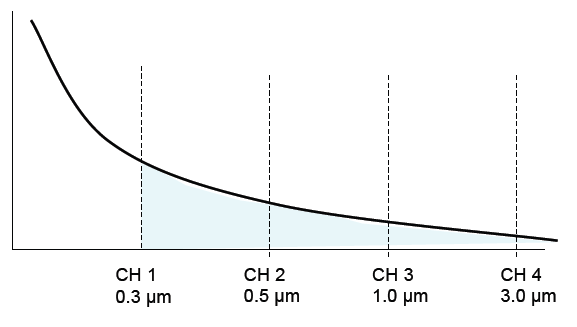
Figure 5. All particles larger than 0.3 μm are counted in the first channel
All particles larger than 0.5 μm are counted in the second channel
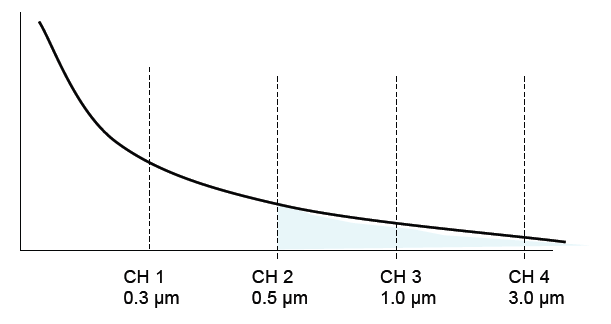
Figure 6. All particles larger than 0.5 μm are counted in the second channel
Important conclusion:
Regardless of the minimum size specified by the Air Particle Counter:
-
All particles larger than the threshold are counted.
-
A counter with a minimum channel of 0.5 μm will count 0.5 μm and larger particles with the same performance as a counter with a minimum channel of 0.3 μm.
The counting efficiency performance specification is independent of the minimum channel size.
Get to know the MET ONE 3400+ Air Particle Counter from Beckman Coulter
Conclusion
This article has shown that:
-
An Air Particle Counter calibrated using standard particles according to ISO 21501 or JIS B9921 will exhibit 50% counting efficiency in ALL channels , regardless of the minimum channel size.
-
In real samples (from controlled environments or clean rooms), all channels will count 100% of the particles larger than the channel threshold , regardless of the specified minimum size.
-
There is no advantage in specifying a lower minimum size threshold in an optical particle counter.
Essential summary:
Reference
-
ISO 21501-4 , Air particle counters by light scattering for clean environments, 2007.