

Self-Contained Multicomponent Breakthrough Analyzer - BTA Frontier
BTA Frontier is a multicomponent breakthrough analyzer (CO2, VOCs, vapors) for precise sorption analysis with temperature control up to 500°C. Request a quote!
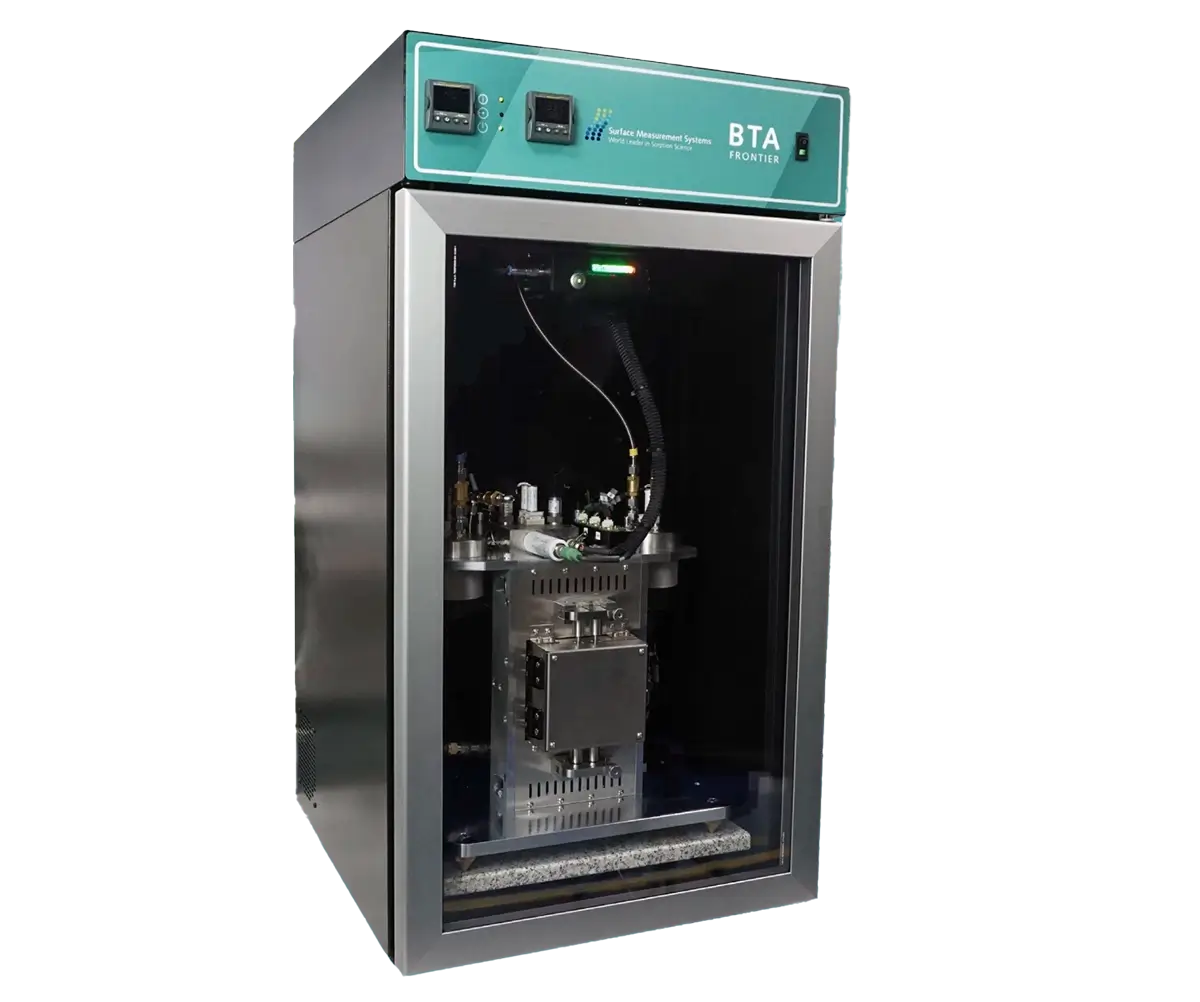
BTA Frontier
BTA Frontier is a multicomponent breakthrough analyzer (CO2, VOCs, vapors) for precise sorption analysis with temperature control up to 500°C. Request a quote!
BTA Frontier is a multicomponent breakthrough analyzer (CO2, VOCs, vapors) for precise sorption analysis with temperature control up to 500°C. Request a quote!
BTA Frontier
BTA Frontier is a multicomponent breakthrough analyzer (CO2, VOCs, vapors) for precise sorption analysis with temperature control up to 500°C. Request a quote!
The BTA Frontier is a revolutionary multicomponent breakthrough analyzer that offers high-precision sorption analysis for industrial and research applications. This self-contained instrument enables direct measurements of breakthrough and equilibration times, providing crucial insights into the behavior of adsorbent materials under real process conditions.
The breakthrough analyzer combines advanced sensor technology with precise temperature and flow control, making it the ideal solution for material characterization, carbon capture, and analysis of volatile organic compounds (VOCs).
Key Topics of the BTA Frontier
- Single-component and multicomponent breakthrough analysis
- Integrated gas generation and mixing system
- Precise temperature control up to 500°C
- Advanced detection of CO2, VOCs, and organic vapors
- Dedicated software for control and data analysis
- Applications in carbon capture and environmental remediation
Advanced Breakthrough Analysis Technology
The breakthrough analysis is essential for understanding how sorbent materials interact with gases and vapors over time. The BTA Frontier performs this analysis with unmatched precision, revealing key properties such as breakthrough times, saturation points, and equilibrium data.
The instrument uses an innovative dual-column design that allows sequential experiments, significantly increasing analytical throughput. This configuration enables simultaneous sample activation while optimizing test schedules for both small- and large-scale studies.
Integrated Multicomponent Detection System
The multicomponent analyzer features a comprehensive set of advanced sensors that ensure accurate detection of multiple analytes. The system includes CO2 sensors for high and low concentrations (ppm to %), a thermal conductivity detector (TCD), PID sensors for VOCs, and a relative humidity sensor.
This versatility enables true competitive sorption analysis, evaluating the adsorption of one gas or vapor in the presence of another component. The system offers independent control over a wide range of gas and vapor concentrations, essential for carbon capture and VOC remediation applications.
Precise Temperature Control for Optimized Performance
The temperature control of the BTA Frontier is fundamental for reproducible and reliable results. The column oven provides stable control up to 500°C with ±0.2°C precision, while the incubator maintains temperatures from 5°C to 60°C with ±0.1°C precision.
This precise thermal control ensures stable generation of organic vapors and water, prevents unwanted condensation, and enables the study of temperature-dependent reactions. The system also increases sensitivity for detecting analytes at low concentrations.
Industrial Applications of the BTA Frontier
The instrument supports several critical industrial applications. In carbon capture , the BTA Frontier evaluates materials for post-combustion capture (PCC) and direct air capture (DAC), testing CO2 adsorption efficiency under various humidity conditions.
For material characterization , the system analyzes adsorption properties of zeolites, MOFs, activated carbon, and other porous materials. In environmental remediation, the instrument tests the efficiency of VOC removal and other atmospheric contaminants.
Versatile Sample and Column Configuration
The system accommodates sample masses from 30 to 3000 mg in various morphologies, including powders, granules, pellets, and fibers. The sample columns are available in multiple inner diameters (2mm, 3mm, 4mm, and 1cm) in both stainless steel and silanized glass.
This flexibility enables analysis of different types of adsorbent materials with optimized configuration for each specific application. The quick-connect design facilitates fast sample exchange and maximizes operational efficiency.
Advantages of the Tested Adsorbent Materials
The BTA Frontier demonstrates excellent performance in characterizing 13X zeolites for carbon capture. Under dry conditions, the material shows high CO2 adsorption capacity (3.6 mmol/g for PCC and 0.5 mmol/g for DAC). The instrument also reveals limitations under humid conditions, where the hydrophilic nature of the zeolite reduces CO2 capture efficiency.
For VOC removal, the system shows that 13X zeolite maintains stable adsorption capacity for toluene (1.95–1.98 mmol/g) under dry conditions, but experiences significant reduction in humid environments due to competition with water.
Dedicated Software for Control and Analysis
The control software allows real-time visualization of data from all flow controllers, sensors, and heating units. It includes a method and sequence builder for creating complex experiments with control over multiple stages, durations, and temperature profiles.
The analysis software automatically compensates for dead volume and calculates adsorptions using system sensor data or an optional integrated mass spectrometer. It offers customizable graphing options and text-format data export, ideal for scientific result presentation.
Advanced Technical Specifications
The BTA Frontier features a vapor generation system with two 50 mL heated reservoirs, a vapor generation range of 0–90% (5–60°C), and ±0.5 p/p0 precision. The humidity measurement system operates from 0–100% RH with ±0.8% RH accuracy (5–40°C).
For CO2 measurement, it offers a percentage-level sensor (0–20% vol) with accuracy up to 0.1% vol, and a ppm-level sensor (0–30,000 ppm) with ±40 ppm accuracy. Organic measurement via PID covers three ranges: low (1 ppb–40 ppm), medium (0–4,000 ppm), and high (0–10,000 ppm).
Dimensions and Construction Features
The instrument has compact dimensions of 520 mm (W) x 980 mm (H) x 610 mm (D) with a weight of 80 kg. It requires electrical power of 200–240 V, 50/60 Hz, 1,500 VA. It is built with a custom 316 stainless steel manifold, Viton seals, and 1/16- or 1/8-inch stainless steel tubing.
The system includes pressure transducers at column inlets and outlets with a 0–2.5 bar range and accuracy better than 1.0% of full scale, temperature-compensated for maximum precision.
FAQ – Frequently Asked Questions About the BTA Frontier
What is the difference between breakthrough analysis and other characterization techniques?
Breakthrough analysis evaluates dynamic adsorption behavior under continuous flow, simulating real process conditions, unlike static techniques that measure only equilibrium capacities.
How does the BTA Frontier measure multiple components simultaneously?
The instrument uses an array of dedicated sensors (CO2, PID, TCD, humidity) that detect different analytes at the same time, enabling competitive sorption analysis and component interaction studies.
What types of materials can be tested in the BTA Frontier?
The system accommodates various materials including zeolites, MOFs, activated carbon, silica gel, porous polymers, and other adsorbents in powder, granule, pellet, or fiber form.
What is the CO2 measurement accuracy for carbon capture applications?
The instrument offers ±40 ppm accuracy for low concentrations (ppm sensor) and up to 0.1% vol accuracy for high concentrations, suitable for PCC and DAC applications.
How does temperature control affect breakthrough results?
Precise temperature control (±0.2°C in the oven, ±0.1°C in the incubator) ensures reproducibility, prevents condensation, and enables study of adsorption thermal dependence.
Can the BTA Frontier simulate real industrial conditions?
Yes, the system allows independent control of concentrations, temperature, humidity, and flow, accurately replicating industrial process conditions.
What are the advantages of the dual-column design?
The design enables sequential experiments with simultaneous sample activation, doubling throughput and optimizing schedules for extensive studies.
Recommended Further Reading
For deeper exploration of related topics, we suggest consulting information on:
- Adsorption isotherm analysis – complementary techniques for full characterization
- Mass spectrometry for gases – advanced analysis of complex mixtures
- MOF materials for carbon capture – emerging technologies in adsorption
Stay in the loop
Get updates, articles and news by email.
Expect news about equipment, services and regulations tailored to your locale.