

Vapor Pressure Analyzer - VPA
The Vapor Pressure Analyzer (VPA) measures the vapor pressures of solids, liquids, and oils using the Knudsen effusion method, ideal for material characterization.
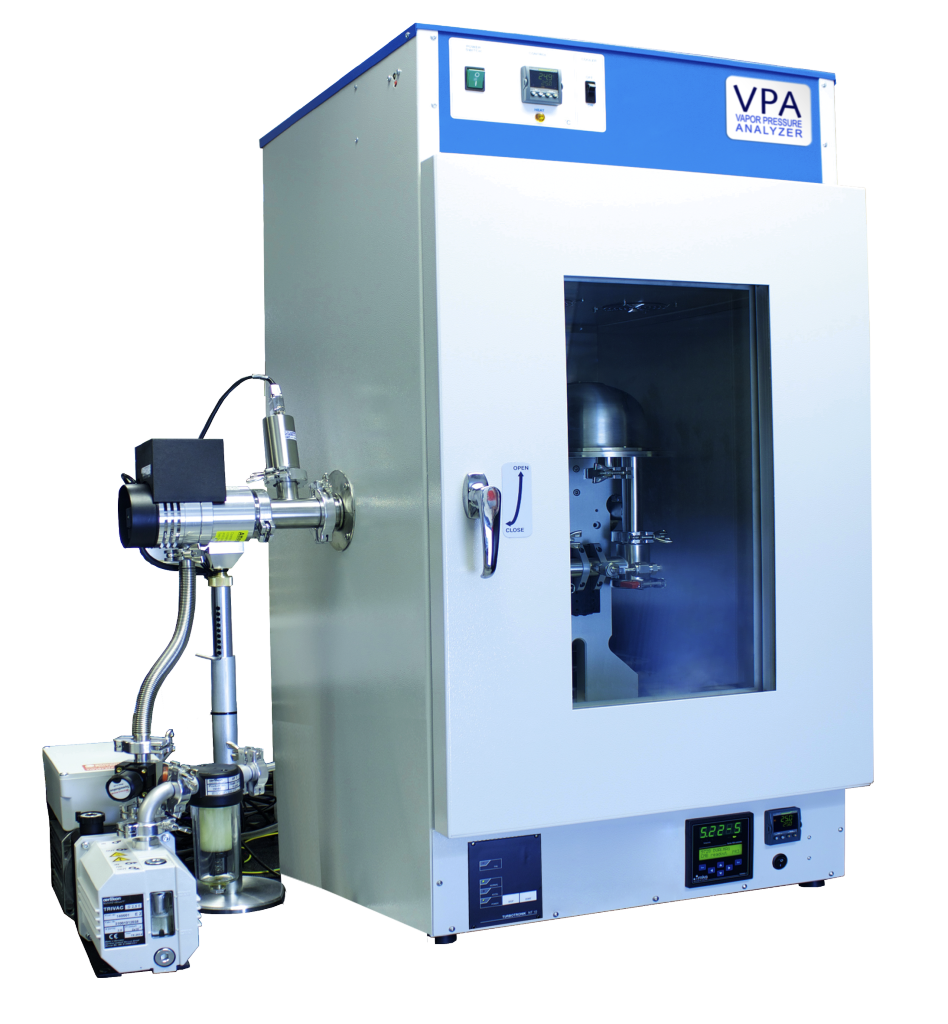
VPA
The Vapor Pressure Analyzer (VPA) measures the vapor pressures of solids, liquids, and oils using the Knudsen effusion method, ideal for material characterization.
The Vapor Pressure Analyzer (VPA) measures the vapor pressures of solids, liquids, and oils using the Knudsen effusion method, ideal for material characterization.
VPA
The Vapor Pressure Analyzer (VPA) measures the vapor pressures of solids, liquids, and oils using the Knudsen effusion method, ideal for material characterization.
Vapor Pressure Analyzer
Vapor Pressure is an important physical property of a material that defines the amount of material in the vapor phase that exists in equilibrium with the original material. All materials enter the vapor phase through sublimation (solid - gas) or evaporation (liquid - gas). The vapor pressure of a material at thermodynamic equilibrium is a fundamental property of the material and is only a function of temperature.
Knudsen Method
The Knudsen effusion method is a dynamic gravimetric technique based on the rate of escape of vapor molecules through an orifice of known dimensions in a Knudsen cell into a vacuum at a known temperature. The mass loss rate through the orifice is measured by the Surface Measurements Systems "UltraBalance" in the VPA system. Sample masses of 1 to 100 mg can typically be studied in the temperature range of 20 to 400 °C.
Temperature Controlled Incubator
The incubator provides a stable and controlled temperature environment for experiments.
- Range: 20 °C to 85 °C
- Stability: ± 0.2 °C (20 °C to 85 °C)
High Temperature Pre-Heater
- The local sample pre-heater heats the sample up to 400 °C.
Vacuum System
- The rotary pump can produce a minimum vacuum pressure of 1 x 10⁻³ Torr.
- The turbomolecular pump in combination with the rotary pump provides lower vacuum pressure down to 1 x 10⁻⁷ Torr.
Vacuum Gauge
- The final vacuum pressure is measured using a vacuum transducer operating in the range of 900 to 1 × 10⁻⁸ Torr.
Vacuum Manifold
- Primarily constructed from 316 stainless steel for chemical inertia, with KF flanges and sealed VCR connections (Cu).
Ultra Microbalance
- Measures the sample mass in real-time at a given temperature and high vacuum.
- Sample Mass: Up to 1.0g
- Mass Change: Up to ±150mg
- Resolution (Accuracy): 0.1 μg
- Peak-to-Peak Noise: ≤ 0.7 μg
Stay in the loop
Get updates, articles and news by email.
Expect news about equipment, services and regulations tailored to your locale.